
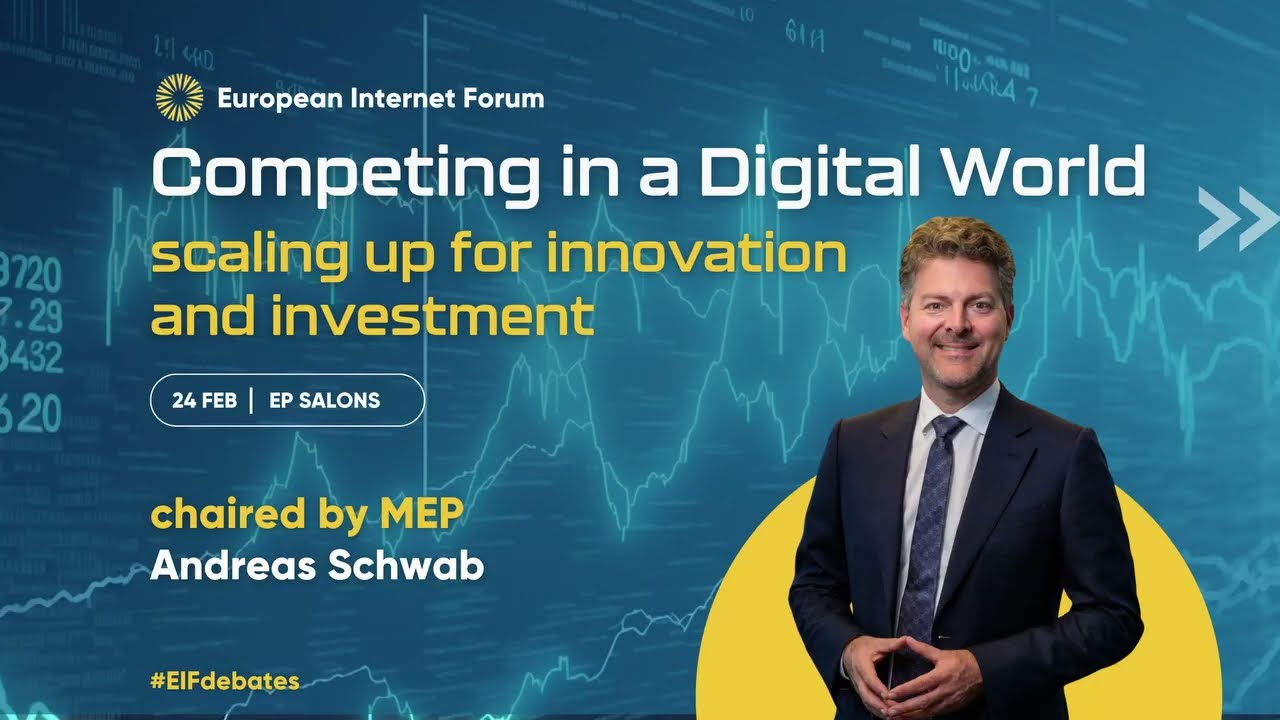
As Europe seeks to strengthen its competitiveness in an increasingly contested global digital landscape, the role of telecommunications infrastructure and market scale has become a central policy question. Against the backdrop of recent reports on Europe’s economic performance and ongoing reflections on EU competition policy, the European Internet Forum convened policymakers, regulators and industry representatives to discuss how merger control and market integration can support innovation and investment. The discussion explored the balance between maintaining strong competition and enabling European companies to achieve the scale required to compete globally. Participants reflected on the implications for the telecom sector, digital markets and the broader functioning of the Single Market.
Opening Remarks
Andreas Schwab MEP opened the discussion by stressing the strategic role of telecommunications networks as the backbone of Europe’s digital economy. Mr Schwab warned that Europe risks falling behind due to market fragmentation, declining profitability in the telecom sector and insufficient investment in network infrastructure. He noted that recent analyses, including economic reports on Europe’s competitiveness, have highlighted structural weaknesses in the sector that undermine Europe’s capacity to support emerging technologies such as artificial intelligence, cloud services and cybersecurity. MEP Schwab emphasised that strengthening the resilience of Europe’s digital infrastructure should remain a central priority for policymakers. He also called for reflection on how regulatory frameworks and merger policy could support greater investment capacity and help operators scale within the European market.
The Commission’s Perspective
Guillaume Loriot, Deputy Director General for Mergers at the European Commission’s Directorate General for Competition, presented the Commission’s ongoing work to revise EU merger guidelines. Mr Loriot explained that the objective is to provide clearer guidance on how mergers are assessed in light of evolving market dynamics, including the role of innovation and long term investment. He stressed that strong competition remains a key driver of productivity and economic growth, noting that empirical evidence consistently shows that competitive markets encourage investment and technological progress. Mr Loriot also underlined that the main obstacle to achieving European scale often lies in the incomplete integration of the Single Market rather than in merger enforcement itself. He emphasised that the Commission evaluates mergers on a case by case basis, carefully weighing their potential benefits and risks for competition and innovation.
Industry Perspectives
Wolfgang Kopf, Senior Vice President for Group Public and Regulatory Affairs at Deutsche Telekom, highlighted the growing investment challenge faced by Europe’s telecommunications sector. Mr Kopf noted that digital infrastructure is responsible for a large share of economic growth and warned that insufficient investment in networks risks undermining Europe’s broader digital ambitions. He argued that fragmentation across national telecom markets and limitations on consolidation have contributed to lower market valuations and reduced incentives for operators to invest at scale. Mr Kopf suggested that the application of competition policy should give greater consideration to efficiencies and investment incentives generated by mergers. He also pointed to international examples where merger remedies were linked to large scale infrastructure investment commitments that ultimately strengthened competition and consumer outcomes.
Alberto Di Felice, Policy and Legal Counsel at DIGITALEUROPE, emphasised the broader competitiveness challenges facing European companies in global markets. Mr Di Felice noted that many European firms increasingly rely on markets outside the Union, particularly the United States, as their primary source of revenue, reflecting the limited scale of Europe’s internal market. He argued that while competition policy is only one element of the broader policy framework, merger enforcement plays a role in shaping companies’ ability to grow and compete internationally. Mr Di Felice stressed that EU merger rules remain principle based and generally effective, but suggested that their application could better account for global competition and dynamic market effects. He underlined the need to maintain case by case assessments while ensuring that competition policy contributes to Europe’s broader competitiveness objectives.
Audrey Scozzaro Ferrazzini, Vice President for Government Affairs at Qualcomm Europe and EIF Board Chair, stressed that Europe must accelerate investment in connectivity, research and development to remain competitive in the global technology landscape. Ms Scozzaro Ferrazzini noted that investment levels in European telecom infrastructure and deployment of advanced connectivity lag behind those in other major economies. She emphasised that strong intellectual property protection and open technology ecosystems are essential to sustaining innovation and the development of global technology standards. Ms Scozzaro Ferrazzini also pointed to structural fragmentation in the European telecom market as a key barrier to achieving scale. She argued that enabling responsible consolidation and ensuring that competition policy reflects innovation and global competition could support Europe’s long term digital leadership.
European Internet Forum ©2026. All Rights Reserved.
