
EU Cybersecurity Act 2 (CSA2)
0:00 / 0:00
open_in_fullFew parts of the proposed Cybersecurity Act revision have drawn as much scrutiny as Title IV, which would let the Union designate high risk suppliers and require their equipment to be removed from critical networks. At its debate on 29 September, the European Internet Forum heard from those who would have to apply the rules: a network vendor, a Member State negotiator, a cloud and software provider and the telecom operators' association. Two questions ran throughout: what should make a vendor high risk, and what evidence and process should stand behind such a decision.
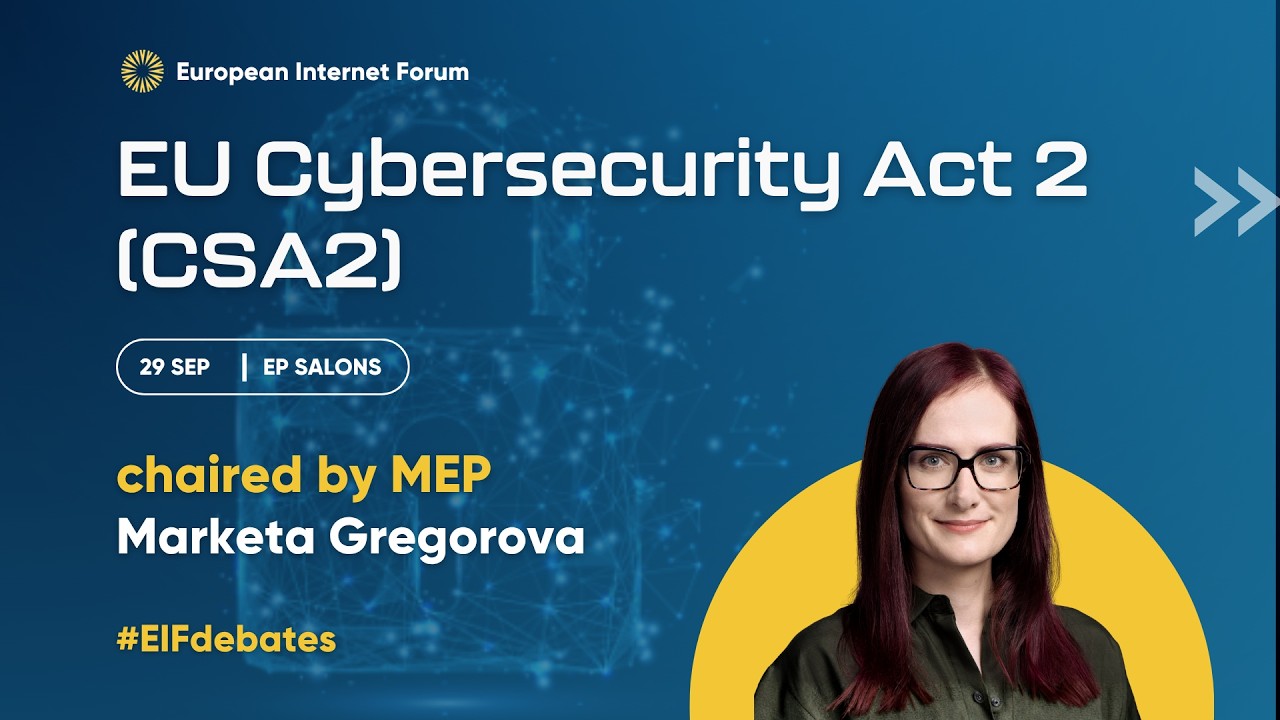
EU Cybersecurity Act 2 (CSA2)
Opening remarks
Markéta Gregorová MEP, who hosted and chaired the debate, explained that the aim was to hear from those who will live with the law rather than those who draft it. She noted that much of the proposal is uncontroversial, and that Title IV is the exception because it gives the Union power to declare a supplier too risky for critical infrastructure. She argued the power is needed, pointing to China's national intelligence law, which obliges companies to assist state intelligence work in secret, and to intrusion campaigns in European and American telecom networks known by names such as Typhoon. The 5G toolbox, she stressed, showed what happens when 27 capitals give 27 different answers on the same vendor. What remains open is how the power should be used: whether conduct, the law of a vendor's jurisdiction or the criticality of what it supplies defines high risk, and on what evidence, seen by whom and with what rights attached. She warned that a designation is closer to a sanction than to a product standard.
A Member State Perspective
Speaking from the Polish perspective, Katarzyna Prusak-Górniak of the Polish Representation to the EU described a file advancing under the Irish presidency, with trilogue preparations in view. Poland welcomes an EU level, risk based approach and supports starting the phase out with mobile networks, while seeing a need for further risk assessment before fixed and satellite networks are covered. She called for objective criteria that take account of ownership structure and third country influence, measures that are evidence based, proportionate and non discriminatory, and a stronger role for Member States. Coherence with the Cyber Resilience Act, a lighter administrative burden and a mechanism to prioritise what to protect first were further priorities. She added that ENISA needs a focused mandate rather than an ever growing one.
Industry Perspectives
Marc Vancoppenolle, Vice President at Nokia, argued that trust in networks is a real world issue, since telecom infrastructure underpins energy, transport, payments, defence and the data flows behind AI. He put the share of Europe's infrastructure relying on untrusted technologies at 30 to 35% and called for CSA2 to cover the full network, including optical transport, IP routing and fixed access, not mobile alone. The 5G toolbox, in his view, did not deliver because voluntary implementation left uneven progress. On cost, he distinguished total replacement cost from the incremental cost of accelerating a transition that would partly happen through routine modernisation, and said the latter is lower than some headline figures. He called for the transition to be completed before 6G arrives from 2030.
Rita Jonusaite, Government Affairs and Public Policy Manager at Google, welcomed the revision as a chance to reduce fragmentation, and first asked for security impact assessments of non-security legislation, citing data localisation requirements in the Cloud and AI Development Act (CADA) as an example. She argued that certification should stay technical and voluntary, noting the shortage of qualified conformity assessment bodies in Europe and the delays seen under the Medical Device Regulation. On the supply chain, she cautioned against rules that blacklist suppliers by country of origin and asked that any high risk designation rest on a case by case assessment of technical posture, governance and operational independence. She also pointed out that cloud providers now face three different foreign dependency tests across CADA, a recent procurement proposal and CSA2, and called for alignment and partnerships with allies.
Pinar Serdengecti, Senior Policy Director at Connect Europe, said telecom operators share the security objective but disagree with the Commission's approach, which places the burden disproportionately on one part of the ecosystem and risks higher prices, less supplier choice and weaker resilience. Operators proposed that restrictions match the evidence rather than extend automatically to fixed transport, satellite and radio access networks, and that decisions be targeted to a specific supplier and network function, with geopolitical analysis informing but not replacing risk assessment. Supplier designation, she argued, involves national security judgments that should remain with the Council and Member States, and phase out periods must follow investment cycles. Where lawfully acquired equipment must be replaced early, she called for fair compensation, warning that otherwise the cost would draw on a limited envelope needed for the 2030 fibre and 5G standalone targets.
Videos
-
Cybersecurity - Tech Masterclass
Cybersecurity - Tech Masterclass
EIF does not take positions on policy issues and expert presentations do not reflect EIF's views.
-
#EIFasks - MEP Beatrice Covassi on the impact of the Cyber Resilience Act
#EIFasks - MEP Beatrice Covassi on the impact of the Cyber Resilience Act
-
2:04
We are EIF: a video tribute to our Members
We are EIF: a video tribute to our Members
The past two years have been challenging and unpredictable for us all. The pandemic has pushed us to reinvent ourselves, to fully embrace the digital world in order to continue delivering value to our membership.
Since then, we have organised over 40 virtual debates, continuing the conversation on the most important topics of the digital policy agenda with MEPs and top-level speakers from the European Commission, CEOs, industry experts and civil society. And #EIFasksMEPs, our first video interview series was born. In 2022, as soon as the covid19 pandemic will allow, we are prepared to welcome you in person at our hybrid and networking events.
Nothing would have been possible without our members' trust and engagement. This video is a tribute to the continuous support that we have received. A story of collective resilience that we wrote together. Because #WEareEIF!
Related content
Policy papers
View allVideos
View all
EU Cybersecurity Act 2 (CSA2) (members only)
Beyond Brussels - EIF MEP visits
Beyond Brussels - EIF MEP visits
Beyond Brussels. Closer to technology.
EIF MEP Visits offer Members of the European Parliament and their staff the opportunity to experience state-of-the-art technologies first-hand, meet the people behind innovation, and explore the opportunities and challenges shaping Europe’s digital future.
From technology hubs and research facilities to major international events, EIF brings policymakers closer to innovation in action, across Europe and beyond.
Through hands-on experiences and direct exchanges with experts, researchers and industry stakeholders, these visits help make digitalisation tangible and provide new perspectives beyond the Brussels policy environment.
Beyond Brussels - EIF MEP visits
Beyond Brussels. Closer to technology.
EIF MEP Visits offer Members of the European Parliament and their staff the opportunity to experience state-of-the-art technologies first-hand, meet the people behind innovation, and explore the opportunities and challenges shaping Europe’s digital future.
From technology hubs and research facilities to major international events, EIF brings policymakers closer to innovation in action, across Europe and beyond.
Through hands-on experiences and direct exchanges with experts, researchers and industry stakeholders, these visits help make digitalisation tangible and provide new perspectives beyond the Brussels policy environment.
Transatlantic Week 2026 - MEP takeaways
Transatlantic Week 2026 - MEP takeaways
Transatlantic Week 2026 - MEP takeaways
Digital Decade Review (members only)
Annual General Assembly 2026 (members only)
Tech Masterclass on Online Scams and Frauds (members only)
The new digital & defense nexus (members only)
Digital Euro and payments interoperability (members only)
Digital Networks Act: Reforming the European Telecoms Market (members only)
MEP visit to Top Tech Sites in Belgium
MEP visit to Top Tech Sites in Belgium
MEP visit to Top Tech Sites in Belgium
European Internet Forum - The story (extended)
European Internet Forum - The story (extended)
25 years of the European Internet Forum — created by MEPs, serving MEPs. A short documentary tracing EIF’s origins in 2000 through its evolution into a neutral space where policymakers, industry, academia and civil society meet to learn, question and shape Europe’s digital future.
About the film: Through interviews with co-founders and leaders, this video tells how EIF began, why it was needed, and how it has grown from debates in Parliament to hands-on study visits and masterclasses.
It touches on key policy moments and looks ahead to the next wave of the internet.
Featuring: James Elles (Co-founder, Former MEP) Erika Mann (Co-founder, Former MEP) Elly Plooij (Co-founder, Former MEP) Pilar del Castillo MEP (Former Chair) Peter Linton (Former EIF Advisor) Maria Rosa Gibellini (Director General)
Credits: All rights to the archive footage used in this film belong to the European Union (European Commission and European Parliament)
Learn more: www.internetforum.eu
European Internet Forum - The story (extended)
25 years of the European Internet Forum — created by MEPs, serving MEPs. A short documentary tracing EIF’s origins in 2000 through its evolution into a neutral space where policymakers, industry, academia and civil society meet to learn, question and shape Europe’s digital future.
About the film: Through interviews with co-founders and leaders, this video tells how EIF began, why it was needed, and how it has grown from debates in Parliament to hands-on study visits and masterclasses.
It touches on key policy moments and looks ahead to the next wave of the internet.
Featuring: James Elles (Co-founder, Former MEP) Erika Mann (Co-founder, Former MEP) Elly Plooij (Co-founder, Former MEP) Pilar del Castillo MEP (Former Chair) Peter Linton (Former EIF Advisor) Maria Rosa Gibellini (Director General)
Credits: All rights to the archive footage used in this film belong to the European Union (European Commission and European Parliament)
Learn more: www.internetforum.eu
EIF 25th Anniversary reception (members only)
MEP visit to MWC25
MEP visit to MWC25
MEP visit to MWC25
Reliable and Resilient Connectivity (members only)
Cybersecurity - Tech Masterclass (members only)
Cloud technology - Tech masterclass (members only)
Cybersecurity - NIS2 implementation (members only)
Risks of Internet Fragmentation (members only)
Exchange with Roberto Viola, Director General, DG CNECT
Exchange with Roberto Viola, Director General, DG CNECT
Exchange with Roberto Viola, Director General, DG CNECT
#EIFasks - MEP Beatrice Covassi on the impact of the Cyber Resilience Act
#EIFasks - MEP Beatrice Covassi on the impact of the Cyber Resilience Act
#EIFasks - MEP Beatrice Covassi on the impact of the Cyber Resilience Act
IGF2023 preparatory meeting (members only)
EIF MEP visit to the GSMA MWC23 Barcelona
EIF MEP visit to the GSMA MWC23 Barcelona
Each year, we invite Members of the European Parliament to an #MWC deep-dive here in Barcelona. Together with the GSMA, we offer MEPs the chance to get a hands-on experience of cutting-edge technology devices, to learn about the latest trends and innovations in mobile technology and to engage with experts on the field.
We meet with representatives of key players in the sphere of technology to exchange views on how innovation and connectivity can change our lives. This year our tour was packed with many interesting demos, from AI-powered networks solutions, sustainability, 6G to Metaverse, Holograms etc.
MWC Barcelona is the largest and most influential event for the connectivity ecosystem and we look forward to be back again next year.
EIF MEP visit to the GSMA MWC23 Barcelona
Each year, we invite Members of the European Parliament to an #MWC deep-dive here in Barcelona. Together with the GSMA, we offer MEPs the chance to get a hands-on experience of cutting-edge technology devices, to learn about the latest trends and innovations in mobile technology and to engage with experts on the field.
We meet with representatives of key players in the sphere of technology to exchange views on how innovation and connectivity can change our lives. This year our tour was packed with many interesting demos, from AI-powered networks solutions, sustainability, 6G to Metaverse, Holograms etc.
MWC Barcelona is the largest and most influential event for the connectivity ecosystem and we look forward to be back again next year.
We are EIF: a video tribute to our Members
We are EIF: a video tribute to our Members
The past two years have been challenging and unpredictable for us all. The pandemic has pushed us to reinvent ourselves, to fully embrace the digital world in order to continue delivering value to our membership.
Since then, we have organised over 40 virtual debates, continuing the conversation on the most important topics of the digital policy agenda with MEPs and top-level speakers from the European Commission, CEOs, industry experts and civil society. And #EIFasksMEPs, our first video interview series was born. In 2022, as soon as the covid19 pandemic will allow, we are prepared to welcome you in person at our hybrid and networking events.
Nothing would have been possible without our members' trust and engagement. This video is a tribute to the continuous support that we have received. A story of collective resilience that we wrote together. Because #WEareEIF!
We are EIF: a video tribute to our Members
The past two years have been challenging and unpredictable for us all. The pandemic has pushed us to reinvent ourselves, to fully embrace the digital world in order to continue delivering value to our membership.
Since then, we have organised over 40 virtual debates, continuing the conversation on the most important topics of the digital policy agenda with MEPs and top-level speakers from the European Commission, CEOs, industry experts and civil society. And #EIFasksMEPs, our first video interview series was born. In 2022, as soon as the covid19 pandemic will allow, we are prepared to welcome you in person at our hybrid and networking events.
Nothing would have been possible without our members' trust and engagement. This video is a tribute to the continuous support that we have received. A story of collective resilience that we wrote together. Because #WEareEIF!
Protecting and empowering children and young people online (members only)
Open RAN (members only)
Virtual debate with ICANN CEO Göran Marby (members only)
The Digital Markets Act: the role of gatekeepers (members only)
Cybersecurity priorities in Europe (members only)
Europe's Digital Sovereignty (members only)
Alex Agius Saliba MEP - The Digital Services Act (members only)
#EIFasks - Encryption, data protection and law enforcement
#EIFasks - Encryption, data protection and law enforcement
On 18 February 2020, EIF hosted a lunch debate where participants discussed the interplay between encryption, data protection and law enforcement.
The debate was hosted by MEPs Patrick Breyer and Rasmus Andresen and featured the following speakers:
- Maximilian Schubert, President of EuroISPA
- Ceren Ünal, Regional Policy Manager Europe, Internet Society
- Birgitta Jónsdóttir, Internet Archive Fellow, Electronic Frontier Foundation
- Bert Hubert, Founder of PowerDNS
- Cathrin Bauer-Bulst, Acting Head of the Cybercrime Unit, DG HOME, European Commission
#EIFasks - Encryption, data protection and law enforcement
On 18 February 2020, EIF hosted a lunch debate where participants discussed the interplay between encryption, data protection and law enforcement.
The debate was hosted by MEPs Patrick Breyer and Rasmus Andresen and featured the following speakers:
- Maximilian Schubert, President of EuroISPA
- Ceren Ünal, Regional Policy Manager Europe, Internet Society
- Birgitta Jónsdóttir, Internet Archive Fellow, Electronic Frontier Foundation
- Bert Hubert, Founder of PowerDNS
- Cathrin Bauer-Bulst, Acting Head of the Cybercrime Unit, DG HOME, European Commission
EIF Reception with Commissioner Thierry Breton - highlights (members only)
Gregory Mounier, Europol - The impact of GDPR (members only)
Ilias Chantzos, Symantec - The impact of GDPR (members only)
Goran Marby, ICANN - The impact of GDPR (members only)
Peter Kouroumbashev MEP, The impact of GDPR (members only)
#EIFAsks on the impact of Internet of Things on European industries
#EIFAsks on the impact of Internet of Things on European industries
On 24 April 2018, MEP Pilar del Castillo and EIF invited MEPs, EIF Members and friends, to exchange views on the impact of Internet of Things on European industries. In this EIFAsks video, MEP Pilar del Castillo, the European Commission Director for the Future Networks Directorate Pearse O'Donohue, Justin Hobbs, from Zebra Technologies and Thomas Walloschke from the Alliance for the Internet of Things Innovation discussed successes and challenges the Union faces in bringing digitalization to Europe’s traditional manufacturing industries.
#EIFAsks on the impact of Internet of Things on European industries
On 24 April 2018, MEP Pilar del Castillo and EIF invited MEPs, EIF Members and friends, to exchange views on the impact of Internet of Things on European industries. In this EIFAsks video, MEP Pilar del Castillo, the European Commission Director for the Future Networks Directorate Pearse O'Donohue, Justin Hobbs, from Zebra Technologies and Thomas Walloschke from the Alliance for the Internet of Things Innovation discussed successes and challenges the Union faces in bringing digitalization to Europe’s traditional manufacturing industries.
#EIFAsks on the proposed EU Cyber Security Act
#EIFAsks on the proposed EU Cyber Security Act
On 20 March 2018, MEP Pilar del Castillo and EIF invited MEPs, EIF Members and friends, to exchange views on the proposed EU Cyber Security Act, and a much needed global approach. In this EIFAsks video, MEP Angelika Niebler (EP rapporteur on the file), the European Commission Director for Cybersecurity Despina Spanou and Ilias Chantzos from Symantec, confer upon the Commission's initiative to counteract future cyber threats and attacks.
#EIFAsks on the proposed EU Cyber Security Act
On 20 March 2018, MEP Pilar del Castillo and EIF invited MEPs, EIF Members and friends, to exchange views on the proposed EU Cyber Security Act, and a much needed global approach. In this EIFAsks video, MEP Angelika Niebler (EP rapporteur on the file), the European Commission Director for Cybersecurity Despina Spanou and Ilias Chantzos from Symantec, confer upon the Commission's initiative to counteract future cyber threats and attacks.
#EIFAsks: What are the main challenges Europe is facing in the cybersecurity sphere?
#EIFAsks: What are the main challenges Europe is facing in the cybersecurity sphere?
On 5th September 2017, EIF and MEPs Pilar del Castillo & Michal Boni, hosted a debate on cybersecurity. The European Union has recently witnessed major security incidents impacting government systems, critical infrastructures, as well as businesses and other public and private organisations of all sizes across several countries. In this #EIFAsks video, MEPs Pilar del Castillo and Michal Boni, Dr. Hugh Thompson from Symantec and Axel Petri from Deutsche Telekom’s share their views on Europe’s main challenges in the sphere of cybersecurity.
#EIFAsks: What are the main challenges Europe is facing in the cybersecurity sphere?
On 5th September 2017, EIF and MEPs Pilar del Castillo & Michal Boni, hosted a debate on cybersecurity. The European Union has recently witnessed major security incidents impacting government systems, critical infrastructures, as well as businesses and other public and private organisations of all sizes across several countries. In this #EIFAsks video, MEPs Pilar del Castillo and Michal Boni, Dr. Hugh Thompson from Symantec and Axel Petri from Deutsche Telekom’s share their views on Europe’s main challenges in the sphere of cybersecurity.
#EIFAsks: Could Wifi be the key to Europe's connectivity?
#EIFAsks: Could Wifi be the key to Europe's connectivity?
On 23 March 2017, EIF and Carlos Zorrinho MEP hosted a debate to discuss the EU pilot project WIFI4EU and how it could help close the digital divide. In this #EIFAsks video, MEP Zorrinho, representatives of the European Commission, Public Libraries and members of the technological industry discuss all aspects of the WIFI4EU initiative including funding and available technologies to make it happen.
#EIFAsks: Could Wifi be the key to Europe's connectivity?
On 23 March 2017, EIF and Carlos Zorrinho MEP hosted a debate to discuss the EU pilot project WIFI4EU and how it could help close the digital divide. In this #EIFAsks video, MEP Zorrinho, representatives of the European Commission, Public Libraries and members of the technological industry discuss all aspects of the WIFI4EU initiative including funding and available technologies to make it happen.
Can the ePrivacy directive strike the right balance between privacy protection & innovation?
Can the ePrivacy directive strike the right balance between privacy protection & innovation?
On 8 February, MEPs Axel Voss and Michal Boni hosted a debate to explore as to whether the co-existence of the General Data Protection regulation and a revised e-privacy Directive is feasible or whether it creates unnecessary overlap and legal uncertainty. In this #EIFasks video, policy makers, industry and consumer rights representatives share their views about balancing the privacy/security conundrum.
Can the ePrivacy directive strike the right balance between privacy protection & innovation?
On 8 February, MEPs Axel Voss and Michal Boni hosted a debate to explore as to whether the co-existence of the General Data Protection regulation and a revised e-privacy Directive is feasible or whether it creates unnecessary overlap and legal uncertainty. In this #EIFasks video, policy makers, industry and consumer rights representatives share their views about balancing the privacy/security conundrum.
#EIFAsks: Does the Privacy Shield solve Europe’s problem?
#EIFAsks: Does the Privacy Shield solve Europe’s problem?
On 15 June 2016, Angelika Niebler MEP invited Renate Nikolay, Head of the Cabinet of Commissioner Vera Jourova, Daniel Fesler from Baker McKenzie, and John Frank from Microsoft, to discuss what Europe needs to fully enjoy the economic advantages of data enabled transatlantic businesses, while ensuring its citizens right to privacy. In the coming days the European Commission will announce the Privacy Shield deal - an outcome of the negotiations with the US counterpart on data transfers across the Atlantic. EIF asked the panellists does the Privacy Shield as it stands solve Europe’s problem?
#EIFAsks: Does the Privacy Shield solve Europe’s problem?
On 15 June 2016, Angelika Niebler MEP invited Renate Nikolay, Head of the Cabinet of Commissioner Vera Jourova, Daniel Fesler from Baker McKenzie, and John Frank from Microsoft, to discuss what Europe needs to fully enjoy the economic advantages of data enabled transatlantic businesses, while ensuring its citizens right to privacy. In the coming days the European Commission will announce the Privacy Shield deal - an outcome of the negotiations with the US counterpart on data transfers across the Atlantic. EIF asked the panellists does the Privacy Shield as it stands solve Europe’s problem?
#EIFAsks Smart Cities: advantages for society & opportunities for businesses
#EIFAsks Smart Cities: advantages for society & opportunities for businesses
On 25 May 2016, Lambert van Nistelrooij, MEP and EIF Steering Committee member, invited representatives from the European Commission, Smart City of Amsterdam and industry to look deeper into the opportunities and issues around this topic. Europe is home to a small number of Smart Cities who have leveraged telecommunications technologies to optimize the way they function, reduce waste & tap whatever efficiencies are to be had from innovatively deploying ICTs. People living and working in Smart Cities not only can enjoy the benefits of convenient living but also innovate and develop new Smart Cities technologies, applicable around the globe. Before the debate started we asked the panel how can Europe take greater social and economic advantage of digital tools and technologies for the organisation of urban space and society? And this is what they had to say...
#EIFAsks Smart Cities: advantages for society & opportunities for businesses
On 25 May 2016, Lambert van Nistelrooij, MEP and EIF Steering Committee member, invited representatives from the European Commission, Smart City of Amsterdam and industry to look deeper into the opportunities and issues around this topic. Europe is home to a small number of Smart Cities who have leveraged telecommunications technologies to optimize the way they function, reduce waste & tap whatever efficiencies are to be had from innovatively deploying ICTs. People living and working in Smart Cities not only can enjoy the benefits of convenient living but also innovate and develop new Smart Cities technologies, applicable around the globe. Before the debate started we asked the panel how can Europe take greater social and economic advantage of digital tools and technologies for the organisation of urban space and society? And this is what they had to say...
#EIFAsks: Trust & Cybersecurity - Are we safe online?
#EIFAsks: Trust & Cybersecurity - Are we safe online?
On 24 May 2016, Pilar del Castillo MEP invited civil society, industry and policy makers to address the importance of trust and cyber-security.An increasing number of cyber attacks makes us worry about our safety online. Consumers trust is crucial for the digital economy to function. EIF seized the opportunity to ask the speakers if we are gaining or losing ground in the race to contain threats to our cyber-security and this is what they had to say...
#EIFAsks: Trust & Cybersecurity - Are we safe online?
On 24 May 2016, Pilar del Castillo MEP invited civil society, industry and policy makers to address the importance of trust and cyber-security.An increasing number of cyber attacks makes us worry about our safety online. Consumers trust is crucial for the digital economy to function. EIF seized the opportunity to ask the speakers if we are gaining or losing ground in the race to contain threats to our cyber-security and this is what they had to say...
Fighting Children Sexual Abuse in the Internet Era
Fighting Children Sexual Abuse in the Internet Era
"Behind every piece of child pornography content online there is a real child suffering from sexual abuse". At the EIF breakfast debate, hosted on 27 April at the European Parliament, Nathalie Griesbeck MEP invited representatives from the Europol's Cybercrime Centre, Missing Children Europe and INHOPE, a network of 51 hotlines in 45 countries worldwide, once again to look into the issue of children safety and raise awareness about this sensitive and important issue. In this video speakers shared their views on how to keep children and youngsters safe in the online world.
Fighting Children Sexual Abuse in the Internet Era
"Behind every piece of child pornography content online there is a real child suffering from sexual abuse". At the EIF breakfast debate, hosted on 27 April at the European Parliament, Nathalie Griesbeck MEP invited representatives from the Europol's Cybercrime Centre, Missing Children Europe and INHOPE, a network of 51 hotlines in 45 countries worldwide, once again to look into the issue of children safety and raise awareness about this sensitive and important issue. In this video speakers shared their views on how to keep children and youngsters safe in the online world.
#EIFasks - The impact of GDPR on cybersecurity and on the development of the Internet
#EIFasks - The impact of GDPR on cybersecurity and on the development of the Internet
On 16 October 2018, EIF hosted a lunch debate on ‘The impact of GDPR on cybersecurity and on the development of the Internet’ chaired by Peter Kouroumbashev MEP and EIF Member.
In this short highlight video, MEP Peter Kouroumbashev, Steve Purser from ENISA, Gregory Mounier of Europol and Ilias Chantzos of Symantec share their views on how GDPR has impacted cybersecurity and the development of the Internet.
#EIFasks - The impact of GDPR on cybersecurity and on the development of the Internet
On 16 October 2018, EIF hosted a lunch debate on ‘The impact of GDPR on cybersecurity and on the development of the Internet’ chaired by Peter Kouroumbashev MEP and EIF Member.
In this short highlight video, MEP Peter Kouroumbashev, Steve Purser from ENISA, Gregory Mounier of Europol and Ilias Chantzos of Symantec share their views on how GDPR has impacted cybersecurity and the development of the Internet.
#EIFasks Casper Klynge, Denmark's Tech Ambassador
#EIFasks Casper Klynge, Denmark's Tech Ambassador
On 29 November 2018, EIF had the pleasure to meet Casper Klynge, the world's first Tech Ambassador, in order to exchange views on #techplomacy, future #digital trends and geopolitical #tech trends with a focus on Europe's position.
#EIFasks Casper Klynge, Denmark's Tech Ambassador
On 29 November 2018, EIF had the pleasure to meet Casper Klynge, the world's first Tech Ambassador, in order to exchange views on #techplomacy, future #digital trends and geopolitical #tech trends with a focus on Europe's position.
#EIFasks - Top 10 Digital Future Trends
#EIFasks - Top 10 Digital Future Trends
On 24 September 2019, Pilar del Castillo MEP and EIF invited members to kick off the new parliamentary season by discussing the "Top 10 Digital Trends that will shape Europe's future and demand Political Leadership".
In this short highlight video, MEP del Castillo, Roberto Viola of the European Commission and Jim Cloos from the EU Council share their views on EU's digital policy priorities.
#EIFasks - Top 10 Digital Future Trends
On 24 September 2019, Pilar del Castillo MEP and EIF invited members to kick off the new parliamentary season by discussing the "Top 10 Digital Trends that will shape Europe's future and demand Political Leadership".
In this short highlight video, MEP del Castillo, Roberto Viola of the European Commission and Jim Cloos from the EU Council share their views on EU's digital policy priorities.
MEPs invite you to join the European Internet Forum
MEPs invite you to join the European Internet Forum
In this video, some of our leading MEPs explain what EIF is invite Members of the European Parliament interested in digital policy topics to join EIF, "one of Brussels' most important fora for debate".
MEPs invite you to join the European Internet Forum
In this video, some of our leading MEPs explain what EIF is invite Members of the European Parliament interested in digital policy topics to join EIF, "one of Brussels' most important fora for debate".
