
The role of simplification - the Digital Omnibus
0:00 / 0:00
open_in_fullThe European Internet Forum hosted a policy debate on the role of simplification in the EU digital framework, focusing on the forthcoming Digital Omnibus. The discussion brought together representatives from the European Commission, industry, and EU agencies to assess how targeted regulatory simplification could support competitiveness while safeguarding fundamental rights. Exchanges centred on artificial intelligence, data protection, and cybersecurity, examining whether the proposed Omnibus can reduce complexity, address implementation challenges, and strengthen coherence across the digital acquis. The event provided a timely platform for reflection as the Commission advances its simplification agenda within the broader context of EU digital policy.
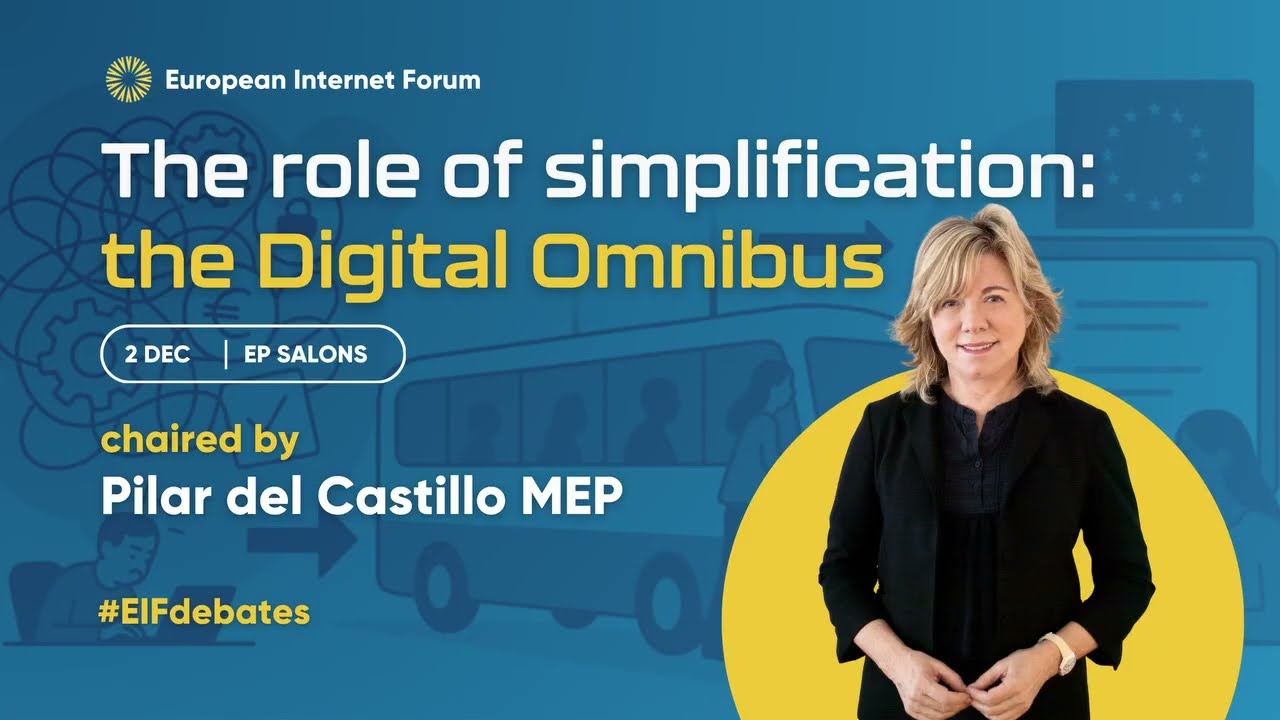
The role of simplification - the Digital Omnibus
Opening Remarks
Pilar del Castillo underlined that the Digital Omnibus marked a shift from expectation to concrete legislative action, stressing its potential to enhance EU competitiveness. She positioned the proposal within the wider digital package, alongside the data union strategy and the European business wallet. She noted that the Omnibus aimed to consolidate the data acquis around the Data Act and the GDPR, while streamlining cybersecurity and AI rules. MEP del Castillo stressed the importance of preserving user rights to access industrial data and flagged open questions around transparency in AI training and the practical exercise of individual rights. She also highlighted the introduction of a single entry point for cybersecurity incident reporting as a key simplification measure.
The Commission’s Perspective
Lucilla Sioli explained that the proposed amendments to the AI Act were targeted technical adjustments aimed at easing implementation without lowering protection standards. She highlighted that the main change concerned delaying the application of high risk AI obligations due to the lack of available standards, while setting a clear end date to avoid indefinite postponement. She outlined complementary measures, including Commission guidelines, common specifications, and extended support for small mid cap companies. She also noted the removal of sanction based obligations on AI literacy in favour of encouragement and stronger innovation tools such as data reuse and sandboxes. On governance, she stressed the proposal to reinforce the role of the AI Office and better align conformity assessments with other sectoral legislation.
Industry views
Marisa Jimenez argued that while the Digital Omnibus signalled progress, it fell short of delivering the regulatory clarity and predictability required by industry. She emphasised that innovation was not yet sufficiently embedded as a guiding principle for regulators, potentially undermining AI investment in Europe. She acknowledged positive steps on governance and bias mitigation but pointed to continued uncertainty around timelines, fragmented implementation, and blurred responsibilities between AI model providers and deployers. She also questioned asymmetric obligations based on company size, arguing for consistent application of safety requirements under a risk based approach. On data protection, she welcomed clarifications on legitimate interest but recalled persistent complexity around cookies and consent.
Maarit Palovirta stressed that European telecom operators strongly supported simplification, citing the cumulative burden of EU legislation and regulatory fragmentation. She argued that this complexity increased costs and constrained investment in digital infrastructure. While welcoming the Digital Omnibus as a positive first step, she considered its impact on the telecom sector to be limited. She highlighted improvements related to GDPR application and AI training data, but noted unresolved overlaps with the e privacy framework. On cybersecurity, she supported the single reporting entry point but called for deeper alignment across EU and national security regimes to meaningfully reduce fragmentation.
ENISA's contribution
Konstantinos Ntantinos outlined ENISA’s work on implementing the cybersecurity elements of the Digital Omnibus, focusing on the development of a single entry point for incident reporting. He noted that cooperation with Member States was already underway, following a flexible approach that respected differing national systems. He indicated that the platform was expected to be operational by the end of 2026 and aimed to be both functional and practical. He acknowledged the complexity of aligning multiple notification regimes while maintaining high cybersecurity standards. He also pointed to the forthcoming review of the Cybersecurity Act as an opportunity for further progress.
Videos
Related content
Policy papers
View allVideos
View all
How to protect minors online? (members only)
EU Cybersecurity Act 2 (CSA2) (members only)
Beyond Brussels - EIF MEP visits
Beyond Brussels - EIF MEP visits
Beyond Brussels. Closer to technology.
EIF MEP Visits offer Members of the European Parliament and their staff the opportunity to experience state-of-the-art technologies first-hand, meet the people behind innovation, and explore the opportunities and challenges shaping Europe’s digital future.
From technology hubs and research facilities to major international events, EIF brings policymakers closer to innovation in action, across Europe and beyond.
Through hands-on experiences and direct exchanges with experts, researchers and industry stakeholders, these visits help make digitalisation tangible and provide new perspectives beyond the Brussels policy environment.
Beyond Brussels - EIF MEP visits
Beyond Brussels. Closer to technology.
EIF MEP Visits offer Members of the European Parliament and their staff the opportunity to experience state-of-the-art technologies first-hand, meet the people behind innovation, and explore the opportunities and challenges shaping Europe’s digital future.
From technology hubs and research facilities to major international events, EIF brings policymakers closer to innovation in action, across Europe and beyond.
Through hands-on experiences and direct exchanges with experts, researchers and industry stakeholders, these visits help make digitalisation tangible and provide new perspectives beyond the Brussels policy environment.
Transatlantic Week 2026 - MEP takeaways
Transatlantic Week 2026 - MEP takeaways
Transatlantic Week 2026 - MEP takeaways
Tech Masterclass on Robotics (members only)
Digital Decade Review (members only)
Annual General Assembly 2026 (members only)
Integrating satellites into Europe’s digital networks (members only)
Tech Masterclass on Online Scams and Frauds (members only)
The new digital & defense nexus (members only)
Digital Euro and payments interoperability (members only)
EU Consumer Law: Present and Future (members only)
Building a sovereign EU cloud ecosystem (members only)
MEP visit to MWC26
MEP visit to MWC26
EIF was proud to bring Members of the European Parliament to MWC 2026 in Barcelona, a hands-on opportunity to exchange directly with tech leaders, explore the latest innovations, and try out emerging technologies shaping Europe's digital future.
Special thanks to our participants: Matthias Ecke MEP, Michal Kobosko MEP, Ondrej Krutilek MEP, Pilar del Castillo MEP, and Brando Benifei MEP, and to GSMA for their collaboration and hospitality in making this visit possible.
MEP visit to MWC26
EIF was proud to bring Members of the European Parliament to MWC 2026 in Barcelona, a hands-on opportunity to exchange directly with tech leaders, explore the latest innovations, and try out emerging technologies shaping Europe's digital future.
Special thanks to our participants: Matthias Ecke MEP, Michal Kobosko MEP, Ondrej Krutilek MEP, Pilar del Castillo MEP, and Brando Benifei MEP, and to GSMA for their collaboration and hospitality in making this visit possible.
Digital Networks Act: Reforming the European Telecoms Market (members only)
MEP visit to Top Tech Sites in Belgium
MEP visit to Top Tech Sites in Belgium
MEP visit to Top Tech Sites in Belgium
The future of the European Standardization System (members only)
The role of simplification - the Digital Omnibus (members only)
Online piracy of live sports and other live events (members only)
Fake science (members only)
MEP visit to imec
MEP visit to imec
MEP visit to imec
European Internet Forum - The story (extended)
European Internet Forum - The story (extended)
25 years of the European Internet Forum — created by MEPs, serving MEPs. A short documentary tracing EIF’s origins in 2000 through its evolution into a neutral space where policymakers, industry, academia and civil society meet to learn, question and shape Europe’s digital future.
About the film: Through interviews with co-founders and leaders, this video tells how EIF began, why it was needed, and how it has grown from debates in Parliament to hands-on study visits and masterclasses.
It touches on key policy moments and looks ahead to the next wave of the internet.
Featuring: James Elles (Co-founder, Former MEP) Erika Mann (Co-founder, Former MEP) Elly Plooij (Co-founder, Former MEP) Pilar del Castillo MEP (Former Chair) Peter Linton (Former EIF Advisor) Maria Rosa Gibellini (Director General)
Credits: All rights to the archive footage used in this film belong to the European Union (European Commission and European Parliament)
Learn more: www.internetforum.eu
European Internet Forum - The story (extended)
25 years of the European Internet Forum — created by MEPs, serving MEPs. A short documentary tracing EIF’s origins in 2000 through its evolution into a neutral space where policymakers, industry, academia and civil society meet to learn, question and shape Europe’s digital future.
About the film: Through interviews with co-founders and leaders, this video tells how EIF began, why it was needed, and how it has grown from debates in Parliament to hands-on study visits and masterclasses.
It touches on key policy moments and looks ahead to the next wave of the internet.
Featuring: James Elles (Co-founder, Former MEP) Erika Mann (Co-founder, Former MEP) Elly Plooij (Co-founder, Former MEP) Pilar del Castillo MEP (Former Chair) Peter Linton (Former EIF Advisor) Maria Rosa Gibellini (Director General)
Credits: All rights to the archive footage used in this film belong to the European Union (European Commission and European Parliament)
Learn more: www.internetforum.eu
EIF 25th Anniversary reception (members only)
MEP visit to MWC25
MEP visit to MWC25
MEP visit to MWC25
Reliable and Resilient Connectivity (members only)
Transatlantic Week 2025 highlights
Transatlantic Week 2025 highlights
Transatlantic Week 2025 highlights
Blockchain - Tech masterclass (members only)
Cybersecurity - Tech Masterclass (members only)
A Union of Skills: Moving the needle on AI and Cyber Skills (members only)
Quantum computing debate (members only)
AI multilateral discussions: connecting the bubbles (members only)
Quantum computing - Tech Masterclass (members only)
Protecting the public from abusive AI-generated content (members only)
AI and connectivity: empowering AI and empowering networks (members only)
Artificial Intelligence - Tech Masterclass (members only)
Cloud technology - Tech masterclass (members only)
AI regulation and investments in Europe – the state of play (members only)
Child protection online (members only)
The Internet - Tech masterclass (members only)
Connectivity infrastructure - Tech masterclass (members only)
Cybersecurity - NIS2 implementation (members only)
Europe's competitiveness in the digital era (members only)
White paper on connectivity: next steps (members only)
Welcome Reception for the new European Parliament (members only)
Risks of Internet Fragmentation (members only)
Exchange with Roberto Viola, Director General, DG CNECT
Exchange with Roberto Viola, Director General, DG CNECT
Exchange with Roberto Viola, Director General, DG CNECT
#EIFasks - MEP Beatrice Covassi on the impact of the Cyber Resilience Act
#EIFasks - MEP Beatrice Covassi on the impact of the Cyber Resilience Act
#EIFasks - MEP Beatrice Covassi on the impact of the Cyber Resilience Act
The future of the European standardization ecosystem – discussion highlights
The future of the European standardization ecosystem – discussion highlights
The future of the European standardization ecosystem – discussion highlights
IGF2023 preparatory meeting (members only)
The future of the European standardization ecosystem (members only)
#EIFasks - Ivan Štefanec MEP on the EIF visit to Israel 2023
#EIFasks - Ivan Štefanec MEP on the EIF visit to Israel 2023
#EIFasks - Ivan Štefanec MEP on the EIF visit to Israel 2023
Navigating the opportunities and challenges of the metaverse (members only)
Automation towards 2040: a conversation with Kevin Barnard (members only)
Navigating the EU cloud regulatory landscape (members only)
EIF MEP visit to the GSMA MWC23 Barcelona
EIF MEP visit to the GSMA MWC23 Barcelona
Each year, we invite Members of the European Parliament to an #MWC deep-dive here in Barcelona. Together with the GSMA, we offer MEPs the chance to get a hands-on experience of cutting-edge technology devices, to learn about the latest trends and innovations in mobile technology and to engage with experts on the field.
We meet with representatives of key players in the sphere of technology to exchange views on how innovation and connectivity can change our lives. This year our tour was packed with many interesting demos, from AI-powered networks solutions, sustainability, 6G to Metaverse, Holograms etc.
MWC Barcelona is the largest and most influential event for the connectivity ecosystem and we look forward to be back again next year.
EIF MEP visit to the GSMA MWC23 Barcelona
Each year, we invite Members of the European Parliament to an #MWC deep-dive here in Barcelona. Together with the GSMA, we offer MEPs the chance to get a hands-on experience of cutting-edge technology devices, to learn about the latest trends and innovations in mobile technology and to engage with experts on the field.
We meet with representatives of key players in the sphere of technology to exchange views on how innovation and connectivity can change our lives. This year our tour was packed with many interesting demos, from AI-powered networks solutions, sustainability, 6G to Metaverse, Holograms etc.
MWC Barcelona is the largest and most influential event for the connectivity ecosystem and we look forward to be back again next year.
Child safety online: fighting child sexual abuse (members only)
EIF-GSMA MEP Visit to MWC22 Barcelona
EIF-GSMA MEP Visit to MWC22 Barcelona
EIF-GSMA MEP Visit to MWC22 Barcelona
#EIFasksMEPs Ep.5 - Eva Maydell on the European Chips Act
#EIFasksMEPs Ep.5 - Eva Maydell on the European Chips Act
A new #EIFasksMEPs episode is out! Eva Maydell MEP answered all our questions on the European Chips Act.
#EIFasksMEPs aims to be an opportunity for our Political members to share views on a topic of choice, in the format of a professionally filmed interview.
Learn more at www.internetforum.eu
#EIFasksMEPs Ep.5 - Eva Maydell on the European Chips Act
A new #EIFasksMEPs episode is out! Eva Maydell MEP answered all our questions on the European Chips Act.
#EIFasksMEPs aims to be an opportunity for our Political members to share views on a topic of choice, in the format of a professionally filmed interview.
Learn more at www.internetforum.eu
AI Governance in Europe - how to make it work? (members only)
#EIFasksMEPs Ep. 4 - interview with Dragos Tudorache on Transatlantic cooperation on AI
#EIFasksMEPs Ep. 4 - interview with Dragos Tudorache on Transatlantic cooperation on AI
A new #EIFasksMEPs episode is out! Dragos Tudorache MEP answered all our questions on the AI Act and the Transatlantic cooperation on Artificial Intelligence.
#EIFasksMEPs aims to be an opportunity for our Political members to share views on a topic of choice, in the format of a professionally filmed interview.
Learn more at www.internetforum.eu
#EIFasksMEPs Ep. 4 - interview with Dragos Tudorache on Transatlantic cooperation on AI
A new #EIFasksMEPs episode is out! Dragos Tudorache MEP answered all our questions on the AI Act and the Transatlantic cooperation on Artificial Intelligence.
#EIFasksMEPs aims to be an opportunity for our Political members to share views on a topic of choice, in the format of a professionally filmed interview.
Learn more at www.internetforum.eu
European Health Data Space (EHDS) (members only)
EIF MEP Visit to New York City
EIF MEP Visit to New York City
On 21 July, EIF organised a one-day visit to New York City for MEPs. The program encompassed visits to Sony Music Entertainment, IBM Innovation Studio, Nokia Bell Labs, NBCUniversal and the United Nations.
EIF MEP Visit to New York City
On 21 July, EIF organised a one-day visit to New York City for MEPs. The program encompassed visits to Sony Music Entertainment, IBM Innovation Studio, Nokia Bell Labs, NBCUniversal and the United Nations.
#EIFasksMEPs Ep.3 - Pilar del Castillo on the Challenges of the Data Economy
#EIFasksMEPs Ep.3 - Pilar del Castillo on the Challenges of the Data Economy
A new #EIFasksMEPs episode is out! Pilar del Castillo MEP did a great job answering all our questions on the "Challenges of the Data Economy". An MEP with the EPP group from Spain, member of the Committee on Industry, Research and Energy (ITRE) and substitute of the Committee on the Internal Market and Consumer Protection (IMCO), Pilar del Castillo has recently been appointed as Rapporteur for the ITRE Committee on the Data Act.
#EIFasksMEPs aims to be an opportunity for our Political members to share views on a topic of choice, in the format of a professionally filmed interview.
#EIFasksMEPs Ep.3 - Pilar del Castillo on the Challenges of the Data Economy
A new #EIFasksMEPs episode is out! Pilar del Castillo MEP did a great job answering all our questions on the "Challenges of the Data Economy". An MEP with the EPP group from Spain, member of the Committee on Industry, Research and Energy (ITRE) and substitute of the Committee on the Internal Market and Consumer Protection (IMCO), Pilar del Castillo has recently been appointed as Rapporteur for the ITRE Committee on the Data Act.
#EIFasksMEPs aims to be an opportunity for our Political members to share views on a topic of choice, in the format of a professionally filmed interview.
EU-US Trade and Tech Council (members only)
European Digital Identity Wallet (members only)
European Chips Act (members only)
Music digital consumption trends (members only)
The Data Act, a path to a fair and innovative data economy? (members only)
ICT sector’s carbon footprint challenge (members only)
EU-Africa partnership: enhancing digital learning for all (members only)
We are EIF: a video tribute to our Members
We are EIF: a video tribute to our Members
The past two years have been challenging and unpredictable for us all. The pandemic has pushed us to reinvent ourselves, to fully embrace the digital world in order to continue delivering value to our membership.
Since then, we have organised over 40 virtual debates, continuing the conversation on the most important topics of the digital policy agenda with MEPs and top-level speakers from the European Commission, CEOs, industry experts and civil society. And #EIFasksMEPs, our first video interview series was born. In 2022, as soon as the covid19 pandemic will allow, we are prepared to welcome you in person at our hybrid and networking events.
Nothing would have been possible without our members' trust and engagement. This video is a tribute to the continuous support that we have received. A story of collective resilience that we wrote together. Because #WEareEIF!
We are EIF: a video tribute to our Members
The past two years have been challenging and unpredictable for us all. The pandemic has pushed us to reinvent ourselves, to fully embrace the digital world in order to continue delivering value to our membership.
Since then, we have organised over 40 virtual debates, continuing the conversation on the most important topics of the digital policy agenda with MEPs and top-level speakers from the European Commission, CEOs, industry experts and civil society. And #EIFasksMEPs, our first video interview series was born. In 2022, as soon as the covid19 pandemic will allow, we are prepared to welcome you in person at our hybrid and networking events.
Nothing would have been possible without our members' trust and engagement. This video is a tribute to the continuous support that we have received. A story of collective resilience that we wrote together. Because #WEareEIF!
IGF2021 – preparatory meeting (members only)
The limits of self-regulation in tackling harmful content (members only)
Digital Markets Act: Where do we stand? (members only)
Protecting and empowering children and young people online (members only)
Digitalisation of the Health Sector (members only)
Debate with EU Commissioner Mariya Gabriel (members only)
Building back Greener and more Digital (members only)
#EIFasksMEPs Ep.2 - Eva Kaili MEP on Artificial Intelligence and its regulation
#EIFasksMEPs Ep.2 - Eva Kaili MEP on Artificial Intelligence and its regulation
A new #EIFasksMEPs episode of our #EIFasksMEPs interview project is out! Eva Kaili MEP did a great job answering all our questions on "Artificial Intelligence and its regulation".
MEP Kaili is a member of the Committee on Industry, Research and Energy and substitute of the Special Committee on Artificial Intelligence in a Digital Age, chairing the STOA Panel, and her work focuses on new technologies and particularly AI. #EIFasksMEPs aims to be an opportunity for our Political members to share views on a topic of choice, in the format of a professionally filmed interview.
Learn more at www.internetforum.eu
#EIFasksMEPs Ep.2 - Eva Kaili MEP on Artificial Intelligence and its regulation
A new #EIFasksMEPs episode of our #EIFasksMEPs interview project is out! Eva Kaili MEP did a great job answering all our questions on "Artificial Intelligence and its regulation".
MEP Kaili is a member of the Committee on Industry, Research and Energy and substitute of the Special Committee on Artificial Intelligence in a Digital Age, chairing the STOA Panel, and her work focuses on new technologies and particularly AI. #EIFasksMEPs aims to be an opportunity for our Political members to share views on a topic of choice, in the format of a professionally filmed interview.
Learn more at www.internetforum.eu
Virtual debate with Qualcomm CEO Steve Mollenkopf (members only)
Open RAN (members only)
#EIFasksMEPs Ep.1 - interview with Ivan Stefanec MEP
#EIFasksMEPs Ep.1 - interview with Ivan Stefanec MEP
The first episode of our new #EIFasksMEPs project features Ivan Stefanec, MEP with the EPP Group and EIF Programming Committee Co-Chair, with whom we discussed "SMEs and digital transformation".
As a member of the IMCO Committee in the European Parliament, MEP Stefanec's work focuses on SMEs, employment, entrepreneurship and the Digital Single Market. #EIFasksMEPs aims to be an opportunity for our Political members to share views on a topic of choice, in the format of a professionally filmed interview.
SUBSCRIBE to not miss the next episode!
#EIFasksMEPs Ep.1 - interview with Ivan Stefanec MEP
The first episode of our new #EIFasksMEPs project features Ivan Stefanec, MEP with the EPP Group and EIF Programming Committee Co-Chair, with whom we discussed "SMEs and digital transformation".
As a member of the IMCO Committee in the European Parliament, MEP Stefanec's work focuses on SMEs, employment, entrepreneurship and the Digital Single Market. #EIFasksMEPs aims to be an opportunity for our Political members to share views on a topic of choice, in the format of a professionally filmed interview.
SUBSCRIBE to not miss the next episode!
Diversity in Tech (members only)
Investing in Europe’s 5G infrastructure as a path to growth (members only)
The role of SMEs in Europe's digital transformation (members only)
Virtual debate with ICANN CEO Göran Marby (members only)
Digital identity: Digital citizenship and e-Government (members only)
EU Industrial Policy for Digital leadership (members only)
Internet Governance Forum 2020 key take-aways (members only)
The Digital Markets Act: the role of gatekeepers (members only)
The European Alliance for Industrial Data and Cloud (members only)
Cybersecurity priorities in Europe (members only)
What is needed for smart farming? (members only)
A European Digital Skills strategy (members only)
Energy transition and Digital revolution (members only)
Europe's Digital Sovereignty (members only)
Geo-blocking: the next steps (members only)
The European Data Strategy (members only)
David Wheeldon, SKY - The Digital Services Act (members only)
Aura Salla, Facebook - The Digital Services Act (members only)
Jan Penfrat, EDRi - The Digital Services Act (members only)
Alex Agius Saliba MEP - The Digital Services Act (members only)
#EIFasks - Encryption, data protection and law enforcement
#EIFasks - Encryption, data protection and law enforcement
On 18 February 2020, EIF hosted a lunch debate where participants discussed the interplay between encryption, data protection and law enforcement.
The debate was hosted by MEPs Patrick Breyer and Rasmus Andresen and featured the following speakers:
- Maximilian Schubert, President of EuroISPA
- Ceren Ünal, Regional Policy Manager Europe, Internet Society
- Birgitta Jónsdóttir, Internet Archive Fellow, Electronic Frontier Foundation
- Bert Hubert, Founder of PowerDNS
- Cathrin Bauer-Bulst, Acting Head of the Cybercrime Unit, DG HOME, European Commission
#EIFasks - Encryption, data protection and law enforcement
On 18 February 2020, EIF hosted a lunch debate where participants discussed the interplay between encryption, data protection and law enforcement.
The debate was hosted by MEPs Patrick Breyer and Rasmus Andresen and featured the following speakers:
- Maximilian Schubert, President of EuroISPA
- Ceren Ünal, Regional Policy Manager Europe, Internet Society
- Birgitta Jónsdóttir, Internet Archive Fellow, Electronic Frontier Foundation
- Bert Hubert, Founder of PowerDNS
- Cathrin Bauer-Bulst, Acting Head of the Cybercrime Unit, DG HOME, European Commission
EIF Reception with Commissioner Thierry Breton - highlights (members only)
Darko Ratkaj, EBU - Very High Capacity Connectivity (members only)
Kyle Whitehill, ESOA - Very High Capacity Connectivity (members only)
Christof Sommerberg, BREKO - Very High Capacity Connectivity (members only)
Breda Corish, Elsevier - Innovations in healthcare delivery (members only)
Onno Hansen-Staszynsky, EZZEV - Emergency warning systems (members only)
Rob Kuipers, X-Guard - Emergency warning systems (members only)
Manuel Cornelisse, one2many - Emergency warning systems (members only)
Pawel Rzeszucinski, Codewise - Social media and democracy (members only)
Erika Widegren, ReImagineEuropa - Social media and democracy (members only)
Sean Evins, Facebook - Social media and democracy (members only)
Gregory Mounier, Europol - The impact of GDPR (members only)
Ilias Chantzos, Symantec - The impact of GDPR (members only)
Goran Marby, ICANN - The impact of GDPR (members only)
Peter Kouroumbashev MEP, The impact of GDPR (members only)
Emilian Pavel MEP, Social media and democracy (members only)
Lambert van Nistelrooij MEP, Social media and democracy (members only)
Casper Klynge, Denmark's Tech Ambassador (members only)
EIFAsks on the options to avoid the disruption of data flows assuming Britain leaves the EU
EIFAsks on the options to avoid the disruption of data flows assuming Britain leaves the EU
On 21 November 2017, EIF & MEPs Pilar del Castillo and Eva Kaili hosted a debate to discuss the impact of Brexit on data flows. Disruptions could not only affect business activities whether in goods and services, but also R&D, the academic world, government lead projects and many public services. In this #EIFAsks video, MEPs Pilar del Castillo and Daniel Dalton, representatives from Vodafone and BTGroup – which heavily rely on uninterrupted data flows – and Giles Derrington from Tech UK – which represents the interests of UK tech companies, assess Britain’s options to avoid disruption on data flows in a post-Brexit scenario.
EIFAsks on the options to avoid the disruption of data flows assuming Britain leaves the EU
On 21 November 2017, EIF & MEPs Pilar del Castillo and Eva Kaili hosted a debate to discuss the impact of Brexit on data flows. Disruptions could not only affect business activities whether in goods and services, but also R&D, the academic world, government lead projects and many public services. In this #EIFAsks video, MEPs Pilar del Castillo and Daniel Dalton, representatives from Vodafone and BTGroup – which heavily rely on uninterrupted data flows – and Giles Derrington from Tech UK – which represents the interests of UK tech companies, assess Britain’s options to avoid disruption on data flows in a post-Brexit scenario.
MEPs in Silicon Valley - 360° angle
MEPs in Silicon Valley - 360° angle
This is 360 video made during the EIF-EU40 visit to the Silicon Valley. For the best viewing experience please use Chrome browser or your phone.
MEPs in Silicon Valley - 360° angle
This is 360 video made during the EIF-EU40 visit to the Silicon Valley. For the best viewing experience please use Chrome browser or your phone.
Day 2 - MEPs in Silicon Valley
Day 2 - MEPs in Silicon Valley
A delegation of 15 Members of the European Parliament* is on a tour of Silicon Valley (18-21/07/16) organised by the European Internet Forum (EIF) and EU40 under the title 'ICT Innovation & Entrepreneurship: the Road to the Valley'.The second day included visits and meetings at Stanford University (Hosts: Dr. Burton Lee), AT&T Foundry, Facebook, SAP Labs and Samsung. *Lambert van Nistelrooij (NL) - head of delegation Michal Boni (PL)Franc Bogovic (SI)Krzysztof Hetman (PL)Cătălin-Sorin Ivan (RO)Ivana Maletic (HR)Miroslav Mikolášik (SK)Sorin Moisa (RO)Cora van Nieuwenhuizen (NL)Andrey Novakov (BG)Jan Olbrycht (PL)Ivan Štefanec (SK)Ana-Claudia Tapardel (RO)Tomáš Zdechovský (CZ)Neena Gill (UK) - on 21/07/16
Day 2 - MEPs in Silicon Valley
A delegation of 15 Members of the European Parliament* is on a tour of Silicon Valley (18-21/07/16) organised by the European Internet Forum (EIF) and EU40 under the title 'ICT Innovation & Entrepreneurship: the Road to the Valley'.The second day included visits and meetings at Stanford University (Hosts: Dr. Burton Lee), AT&T Foundry, Facebook, SAP Labs and Samsung. *Lambert van Nistelrooij (NL) - head of delegation Michal Boni (PL)Franc Bogovic (SI)Krzysztof Hetman (PL)Cătălin-Sorin Ivan (RO)Ivana Maletic (HR)Miroslav Mikolášik (SK)Sorin Moisa (RO)Cora van Nieuwenhuizen (NL)Andrey Novakov (BG)Jan Olbrycht (PL)Ivan Štefanec (SK)Ana-Claudia Tapardel (RO)Tomáš Zdechovský (CZ)Neena Gill (UK) - on 21/07/16
Day 1 - MEPs in Silicon Valley
Day 1 - MEPs in Silicon Valley
A delegation of 15 Members of the European Parliament* is on a tour of Silicon Valley (18-21/07/16) organised by the European Internet Forum (EIF) and EU40 under the title 'ICT Innovation & Entrepreneurship: the Road to the Valley'. The first day included visits and meetings with Neumann Society, Ericsson, Intel, Cisco, eBay, Apple and Sky Ventures. *Lambert van Nistelrooij (NL) - head of delegation Michal Boni (PL)Franc Bogovic (SI)Krzysztof Hetman (PL)Cătălin-Sorin Ivan (RO)Ivana Maletic (HR)Miroslav Mikolášik (SK)Sorin Moisa (RO)Cora van Nieuwenhuizen (NL)Andrey Novakov (BG)Jan Olbrycht (PL)Ivan Štefanec (SK)Ana-Claudia Tapardel (RO)Tomáš Zdechovský (CZ)Neena Gill (UK) - on 21/07/16
Day 1 - MEPs in Silicon Valley
A delegation of 15 Members of the European Parliament* is on a tour of Silicon Valley (18-21/07/16) organised by the European Internet Forum (EIF) and EU40 under the title 'ICT Innovation & Entrepreneurship: the Road to the Valley'. The first day included visits and meetings with Neumann Society, Ericsson, Intel, Cisco, eBay, Apple and Sky Ventures. *Lambert van Nistelrooij (NL) - head of delegation Michal Boni (PL)Franc Bogovic (SI)Krzysztof Hetman (PL)Cătălin-Sorin Ivan (RO)Ivana Maletic (HR)Miroslav Mikolášik (SK)Sorin Moisa (RO)Cora van Nieuwenhuizen (NL)Andrey Novakov (BG)Jan Olbrycht (PL)Ivan Štefanec (SK)Ana-Claudia Tapardel (RO)Tomáš Zdechovský (CZ)Neena Gill (UK) - on 21/07/16
Day 3 - MEPs in Silicon Valley
Day 3 - MEPs in Silicon Valley
A delegation of 15 Members of the European Parliament* is on a tour of Silicon Valley (18-21/07/16) organised by the European Internet Forum (EIF) and EU40 under the title 'ICT Innovation & Entrepreneurship: the Road to the Valley'.The third day included visits and meetings at Microsoft, Google, Amazon, Symantec, Nokia and Deutsche Telekom T-Labs. *Lambert van Nistelrooij (NL) - head of delegation Michal Boni (PL)Franc Bogovic (SI)Krzysztof Hetman (PL)Cătălin-Sorin Ivan (RO)Ivana Maletic (HR)Miroslav Mikolášik (SK)Sorin Moisa (RO)Cora van Nieuwenhuizen (NL)Andrey Novakov (BG)Jan Olbrycht (PL)Ivan Štefanec (SK)Ana-Claudia Tapardel (RO)Tomáš Zdechovský (CZ)Neena Gill (UK) - on 21/07/16
Day 3 - MEPs in Silicon Valley
A delegation of 15 Members of the European Parliament* is on a tour of Silicon Valley (18-21/07/16) organised by the European Internet Forum (EIF) and EU40 under the title 'ICT Innovation & Entrepreneurship: the Road to the Valley'.The third day included visits and meetings at Microsoft, Google, Amazon, Symantec, Nokia and Deutsche Telekom T-Labs. *Lambert van Nistelrooij (NL) - head of delegation Michal Boni (PL)Franc Bogovic (SI)Krzysztof Hetman (PL)Cătălin-Sorin Ivan (RO)Ivana Maletic (HR)Miroslav Mikolášik (SK)Sorin Moisa (RO)Cora van Nieuwenhuizen (NL)Andrey Novakov (BG)Jan Olbrycht (PL)Ivan Štefanec (SK)Ana-Claudia Tapardel (RO)Tomáš Zdechovský (CZ)Neena Gill (UK) - on 21/07/16
Day 4 - MEPs in Silicon Valley
Day 4 - MEPs in Silicon Valley
A delegation of 15 Members of the European Parliament* went on a tour of Silicon Valley (18-21/07/16) organised by the European Internet Forum (EIF) and EU40 under the title 'ICT Innovation & Entrepreneurship: the Road to the Valley'.The fourth (and last) day included visits and meetings at the German Accelerator, Yelp, Orange Fab, Uber, EIT Digital and Allied for Startups. *Lambert van Nistelrooij (NL) - head of delegation Michal Boni (PL)Franc Bogovic (SI)Krzysztof Hetman (PL)Cătălin-Sorin Ivan (RO)Ivana Maletic (HR)Miroslav Mikolášik (SK)Sorin Moisa (RO)Cora van Nieuwenhuizen (NL)Andrey Novakov (BG)Jan Olbrycht (PL)Ivan Štefanec (SK)Ana-Claudia Tapardel (RO)Tomáš Zdechovský (CZ)Neena Gill (UK) - on 21/07/16
Day 4 - MEPs in Silicon Valley
A delegation of 15 Members of the European Parliament* went on a tour of Silicon Valley (18-21/07/16) organised by the European Internet Forum (EIF) and EU40 under the title 'ICT Innovation & Entrepreneurship: the Road to the Valley'.The fourth (and last) day included visits and meetings at the German Accelerator, Yelp, Orange Fab, Uber, EIT Digital and Allied for Startups. *Lambert van Nistelrooij (NL) - head of delegation Michal Boni (PL)Franc Bogovic (SI)Krzysztof Hetman (PL)Cătălin-Sorin Ivan (RO)Ivana Maletic (HR)Miroslav Mikolášik (SK)Sorin Moisa (RO)Cora van Nieuwenhuizen (NL)Andrey Novakov (BG)Jan Olbrycht (PL)Ivan Štefanec (SK)Ana-Claudia Tapardel (RO)Tomáš Zdechovský (CZ)Neena Gill (UK) - on 21/07/16
Sir Tim Berners-Lee on Magna Carta for the Internet
Sir Tim Berners-Lee on Magna Carta for the Internet
On 18 November, 2014 Sir Tim Berners Lee, the father of the internet, discussed the future of the internet with EIF members & friends, looking at the threats to the web’s wide-open spaces and addressing the most important question: what web do we want?
Sir Tim Berners-Lee on Magna Carta for the Internet
On 18 November, 2014 Sir Tim Berners Lee, the father of the internet, discussed the future of the internet with EIF members & friends, looking at the threats to the web’s wide-open spaces and addressing the most important question: what web do we want?
#EIFasks EU Commissioner Gabriel and Romanian Ambassador on the future of Digital Single Market
#EIFasks EU Commissioner Gabriel and Romanian Ambassador on the future of Digital Single Market
On January 29th, EIF invited MEPs, Members and friends for an exchange of views on the future of the EU Digital Single Market.
In this highlights video, EU Commissioner Mariya Gabriel and Ambassador Luminita Odobescu, Permanent Representative of Romania to the EU share their views on the EU Digital Single Market.
#EIFasks EU Commissioner Gabriel and Romanian Ambassador on the future of Digital Single Market
On January 29th, EIF invited MEPs, Members and friends for an exchange of views on the future of the EU Digital Single Market.
In this highlights video, EU Commissioner Mariya Gabriel and Ambassador Luminita Odobescu, Permanent Representative of Romania to the EU share their views on the EU Digital Single Market.
#EIFasks - The race for AI Leadership
#EIFasks - The race for AI Leadership
On 19 February 2019, Pilar del Castillo MEP and EIF invited members for an exchange of views on how Europe can succeed against China and the US in the global race for AI leadership.
#EIFasks - The race for AI Leadership
On 19 February 2019, Pilar del Castillo MEP and EIF invited members for an exchange of views on how Europe can succeed against China and the US in the global race for AI leadership.
#EIFasks - Tech saving lives: Emergency warning systems
#EIFasks - Tech saving lives: Emergency warning systems
On 20 February 2019, MEP Lambert van Nistelrooij and EIF invited members for an exchange of views on how modern technologies can warn and protect EU citizens in case of emergency.
#EIFasks - Tech saving lives: Emergency warning systems
On 20 February 2019, MEP Lambert van Nistelrooij and EIF invited members for an exchange of views on how modern technologies can warn and protect EU citizens in case of emergency.
#EIFasks - Innovations in healthcare delivery
#EIFasks - Innovations in healthcare delivery
On 5th March 2019, Michal Boni MEP and EIF invited members for an exchange of views and provide insights and real life examples of how digitisation is impacting European healthcare.
In this short highlight video, Michal Boni MEP, Dr. Thomas Kostera from Bertelsmann Stiftung and Breda Corish of Elsevier provide insights and real life examples of how digitisation is impacting European healthcare.
#EIFasks - Innovations in healthcare delivery
On 5th March 2019, Michal Boni MEP and EIF invited members for an exchange of views and provide insights and real life examples of how digitisation is impacting European healthcare.
In this short highlight video, Michal Boni MEP, Dr. Thomas Kostera from Bertelsmann Stiftung and Breda Corish of Elsevier provide insights and real life examples of how digitisation is impacting European healthcare.
#EIFasks - Digital transformation and taxation
#EIFasks - Digital transformation and taxation
What are the key challenges and opportunities that digital transformation brings to EU taxation?
On 12 November 2019, Ivan Stefanec MEP invited EIF members for a discussion on this timely topic. The debate featured the following speakers:
- Maria Teresa Fabregas, Director of Indirect taxation and tax administration Unit, DG TAXUD, European Commission
- Magdalena Piech, Head of Regulatory Affairs at Allegro, Chair of the European Tech Alliance
- Rob Burlison, Director of Global Corporate Affairs, Intuit
- Dr. Horst Heitz, Deputy Secretary General, Taxpayers Association of Europe
#EIFasks - Digital transformation and taxation
What are the key challenges and opportunities that digital transformation brings to EU taxation?
On 12 November 2019, Ivan Stefanec MEP invited EIF members for a discussion on this timely topic. The debate featured the following speakers:
- Maria Teresa Fabregas, Director of Indirect taxation and tax administration Unit, DG TAXUD, European Commission
- Magdalena Piech, Head of Regulatory Affairs at Allegro, Chair of the European Tech Alliance
- Rob Burlison, Director of Global Corporate Affairs, Intuit
- Dr. Horst Heitz, Deputy Secretary General, Taxpayers Association of Europe
#EIFasks - IGF 2019 preparatory meeting
#EIFasks - IGF 2019 preparatory meeting
On 13 November 2019, EIF and MEP Marina Kaljurand invited MEPs, Members and friends for an exchange of views regarding the priorities and expectations for this year's Internet Governance Forum.
The debate titled "IGF 2019 preparatory meeting" featured the following speakers:
- Pearse O'Donohue, Director for the Future Networks Directorate, DG CONNECT, European Commission
- Sandra Hoferichter, Secretary General, EuroDIG
- Lina Galvez Muñoz MEP, Head of the European Parliament Delegation to the Internet Governance Forum 2019
- Florian Pennings, EU Cybersecurity Policy Manager, Microsoft
#EIFasks - IGF 2019 preparatory meeting
On 13 November 2019, EIF and MEP Marina Kaljurand invited MEPs, Members and friends for an exchange of views regarding the priorities and expectations for this year's Internet Governance Forum.
The debate titled "IGF 2019 preparatory meeting" featured the following speakers:
- Pearse O'Donohue, Director for the Future Networks Directorate, DG CONNECT, European Commission
- Sandra Hoferichter, Secretary General, EuroDIG
- Lina Galvez Muñoz MEP, Head of the European Parliament Delegation to the Internet Governance Forum 2019
- Florian Pennings, EU Cybersecurity Policy Manager, Microsoft
#EIFasks - The digital transformation of the financial sector
#EIFasks - The digital transformation of the financial sector
In 2019 EIF invited members to exchange views on the regulatory obstacles Banks and FinTechs are facing in the Digital Era as well as how to ensure that competition, data privacy and security will empower the consumer and SMEs while allowing the sector to lead in innovation.
The debate, titled "The digital transformation of financial services", was chaired by MEP Pilar del Castillo and featured the following speakers:
- Delphine Leroy, Policy Officer, Financial Technology and Sustainable Finance Unit, DG FISMA, European Commission
- Joel Rosenbaum, Head of Strategy and Corporate Development, Banco Santander
- Ciaran O'Malley, Head of Commercial Strategy, Trustly
#EIFasks - The digital transformation of the financial sector
In 2019 EIF invited members to exchange views on the regulatory obstacles Banks and FinTechs are facing in the Digital Era as well as how to ensure that competition, data privacy and security will empower the consumer and SMEs while allowing the sector to lead in innovation.
The debate, titled "The digital transformation of financial services", was chaired by MEP Pilar del Castillo and featured the following speakers:
- Delphine Leroy, Policy Officer, Financial Technology and Sustainable Finance Unit, DG FISMA, European Commission
- Joel Rosenbaum, Head of Strategy and Corporate Development, Banco Santander
- Ciaran O'Malley, Head of Commercial Strategy, Trustly
#EIFasks - How do third countries envisage their digital agenda?
#EIFasks - How do third countries envisage their digital agenda?
On 10 July 2018, Pilar del Castillo MEP and EIF Chair exchanged views on 'How do third countries envisage their digital agenda?' with prominent speakers and EIF members at the European Parliament in Brussels. In this #EIFAsks video MEP Pilar del Castillo, Shintaro Ogi from Europe Center, José Juan Haro from Telefonica and Praveen Paranjothi from Startup Europe India Network give their views on what should be the EU’s priority issues when engaging in digital dialogue with third countries.
#EIFasks - How do third countries envisage their digital agenda?
On 10 July 2018, Pilar del Castillo MEP and EIF Chair exchanged views on 'How do third countries envisage their digital agenda?' with prominent speakers and EIF members at the European Parliament in Brussels. In this #EIFAsks video MEP Pilar del Castillo, Shintaro Ogi from Europe Center, José Juan Haro from Telefonica and Praveen Paranjothi from Startup Europe India Network give their views on what should be the EU’s priority issues when engaging in digital dialogue with third countries.
#EIFasks - World Refugee Day: the role of the Internet and ICTs
#EIFasks - World Refugee Day: the role of the Internet and ICTs
On the occasion of the World Refugee Day on 20 June 2018, MEP Julie Ward exchanged views on ’Refugees and the role of the Internet and ICTs' with prominent speakers and EIF members at the European Parliament in Brussels. EIF asked what more we can do to improve refugee life with ICTs. Speakers: - Veronique de Leener, Founder and Director of MAKS vzw in Brussels - Jenny Casswell, Insights Manager of 'Mobile for Humanitarian Innovation Programme', GSMA - Elie Ayoub, Chief of ICT Emergency Preparedness and Response, UN Refugee Agency (UNHCR) - Mike Carter, Vice-President Operations at INMARSAT; Team Rubicon volunteer
#EIFasks - World Refugee Day: the role of the Internet and ICTs
On the occasion of the World Refugee Day on 20 June 2018, MEP Julie Ward exchanged views on ’Refugees and the role of the Internet and ICTs' with prominent speakers and EIF members at the European Parliament in Brussels. EIF asked what more we can do to improve refugee life with ICTs. Speakers: - Veronique de Leener, Founder and Director of MAKS vzw in Brussels - Jenny Casswell, Insights Manager of 'Mobile for Humanitarian Innovation Programme', GSMA - Elie Ayoub, Chief of ICT Emergency Preparedness and Response, UN Refugee Agency (UNHCR) - Mike Carter, Vice-President Operations at INMARSAT; Team Rubicon volunteer
#EIFasks on Artificial Intelligence and Ethics
#EIFasks on Artificial Intelligence and Ethics
On 19 June 2018, MEP Emilian Pavel exchanged views on 'Artificial Intelligence and Ethics' with prominent speakers and EIF members at the European Parliament in Brussels. - Leo Kärkkäinen, Chief AI Officer at Nokia and Professor on AI at Aalto University - Lucilla Sioli, Director, Digital Industry, DG CNECT, European Commission - Prof Raja Chatila, Chair of the IEEE Global Initiative for Ethical Considerations in AI and Autonomous Systems EIF asked them what Europe’s priorities should be to help ensure AI is developed globally to respect human rights and freedoms.
#EIFasks on Artificial Intelligence and Ethics
On 19 June 2018, MEP Emilian Pavel exchanged views on 'Artificial Intelligence and Ethics' with prominent speakers and EIF members at the European Parliament in Brussels. - Leo Kärkkäinen, Chief AI Officer at Nokia and Professor on AI at Aalto University - Lucilla Sioli, Director, Digital Industry, DG CNECT, European Commission - Prof Raja Chatila, Chair of the IEEE Global Initiative for Ethical Considerations in AI and Autonomous Systems EIF asked them what Europe’s priorities should be to help ensure AI is developed globally to respect human rights and freedoms.
#EIFasks - Technology driving sustainability: the role of e-Mobility
#EIFasks - Technology driving sustainability: the role of e-Mobility
On 15 May 2018, MEP Adina-Ioana Valean, Chair of ENVI Committee (Environment, Public Health and Food Safety) exchanged views on technology driving sustainability and the role of e-Mobility with EIF and EEF Members and friends. In this #EIFasks video we asked MEP Valean, European Commission Energy Policy Director Megan Richards, Enel Head of e-Mobility Alberto Piglia and Uber Public Policy Associate Laurin Sepoetro what role EU policy must play to accelerate the development of e-mobility and what specific steps need to be taken.
#EIFasks - Technology driving sustainability: the role of e-Mobility
On 15 May 2018, MEP Adina-Ioana Valean, Chair of ENVI Committee (Environment, Public Health and Food Safety) exchanged views on technology driving sustainability and the role of e-Mobility with EIF and EEF Members and friends. In this #EIFasks video we asked MEP Valean, European Commission Energy Policy Director Megan Richards, Enel Head of e-Mobility Alberto Piglia and Uber Public Policy Associate Laurin Sepoetro what role EU policy must play to accelerate the development of e-mobility and what specific steps need to be taken.
#EIFAsks on Cultural Heritage and Innovation
#EIFAsks on Cultural Heritage and Innovation
On 25 April 2018, MEP Julie Ward and EIF invited MEPs, EIF Members and friends, to exchange views on Cultural Heritage and innovation. In this EIFAsks video, MEP Julie Ward, the European Commission Head of Unit DG RTD Birgit de Boissezon, Cristina Mussinelli, Secretary General of LIA Foundation (Italian Accessible Books), on Rombouts, former Mayor of 's-Hertogenbosch and Member of the European Heritage Label Expert Panel and Eleanor Kenny, Head of Communications, Europeana Foundation discussed cultural heritage and innovation.
#EIFAsks on Cultural Heritage and Innovation
On 25 April 2018, MEP Julie Ward and EIF invited MEPs, EIF Members and friends, to exchange views on Cultural Heritage and innovation. In this EIFAsks video, MEP Julie Ward, the European Commission Head of Unit DG RTD Birgit de Boissezon, Cristina Mussinelli, Secretary General of LIA Foundation (Italian Accessible Books), on Rombouts, former Mayor of 's-Hertogenbosch and Member of the European Heritage Label Expert Panel and Eleanor Kenny, Head of Communications, Europeana Foundation discussed cultural heritage and innovation.
#EIFAsks on the impact of Internet of Things on European industries
#EIFAsks on the impact of Internet of Things on European industries
On 24 April 2018, MEP Pilar del Castillo and EIF invited MEPs, EIF Members and friends, to exchange views on the impact of Internet of Things on European industries. In this EIFAsks video, MEP Pilar del Castillo, the European Commission Director for the Future Networks Directorate Pearse O'Donohue, Justin Hobbs, from Zebra Technologies and Thomas Walloschke from the Alliance for the Internet of Things Innovation discussed successes and challenges the Union faces in bringing digitalization to Europe’s traditional manufacturing industries.
#EIFAsks on the impact of Internet of Things on European industries
On 24 April 2018, MEP Pilar del Castillo and EIF invited MEPs, EIF Members and friends, to exchange views on the impact of Internet of Things on European industries. In this EIFAsks video, MEP Pilar del Castillo, the European Commission Director for the Future Networks Directorate Pearse O'Donohue, Justin Hobbs, from Zebra Technologies and Thomas Walloschke from the Alliance for the Internet of Things Innovation discussed successes and challenges the Union faces in bringing digitalization to Europe’s traditional manufacturing industries.
#EIFAsks on how to provide a digital economy and society
#EIFAsks on how to provide a digital economy and society
On 21 March 2018, MEP Michal Boni and EIF invited MEPs, EIF Members and friends, to discuss how to ensure that digital is prioritised in the next Multiannual Financial Framework, from artificial intelligence to cyber-security and from copyright to ensuring high speed internet access. In this EIFAsks video EU Commissioner for Budget, Günther Oettinger, MEPs Jan Olbrycht (MFF co-rapporteur) and Michal Boni, and Kalin Tomov from the Bulgarian Permanent Representation, give their views on how to support Europe's digitisation through the next MFF.
#EIFAsks on how to provide a digital economy and society
On 21 March 2018, MEP Michal Boni and EIF invited MEPs, EIF Members and friends, to discuss how to ensure that digital is prioritised in the next Multiannual Financial Framework, from artificial intelligence to cyber-security and from copyright to ensuring high speed internet access. In this EIFAsks video EU Commissioner for Budget, Günther Oettinger, MEPs Jan Olbrycht (MFF co-rapporteur) and Michal Boni, and Kalin Tomov from the Bulgarian Permanent Representation, give their views on how to support Europe's digitisation through the next MFF.
#EIFAsks on the proposed EU Cyber Security Act
#EIFAsks on the proposed EU Cyber Security Act
On 20 March 2018, MEP Pilar del Castillo and EIF invited MEPs, EIF Members and friends, to exchange views on the proposed EU Cyber Security Act, and a much needed global approach. In this EIFAsks video, MEP Angelika Niebler (EP rapporteur on the file), the European Commission Director for Cybersecurity Despina Spanou and Ilias Chantzos from Symantec, confer upon the Commission's initiative to counteract future cyber threats and attacks.
#EIFAsks on the proposed EU Cyber Security Act
On 20 March 2018, MEP Pilar del Castillo and EIF invited MEPs, EIF Members and friends, to exchange views on the proposed EU Cyber Security Act, and a much needed global approach. In this EIFAsks video, MEP Angelika Niebler (EP rapporteur on the file), the European Commission Director for Cybersecurity Despina Spanou and Ilias Chantzos from Symantec, confer upon the Commission's initiative to counteract future cyber threats and attacks.
#EIFAsks if self-regulation will be sufficient to tackle Fake News
#EIFAsks if self-regulation will be sufficient to tackle Fake News
On 6 March 2018, MEP Eva Kaili and EIF invited MEPs, EIF Members and friends to debate how to tackle hate speech and fake news while safeguarding freedom of expression. In this EIFAsks video, MEP Eva Kaili, Susan Ness (former Commissioner of the US Federal Communications Commission), Italian journalist Roberto Tallei, Ronald Eissen from the International Network Against Cyber Hate and Wout van Wijk from News Media Europe, assess if self-regulation is sufficient to address the fake news phenomenon.
#EIFAsks if self-regulation will be sufficient to tackle Fake News
On 6 March 2018, MEP Eva Kaili and EIF invited MEPs, EIF Members and friends to debate how to tackle hate speech and fake news while safeguarding freedom of expression. In this EIFAsks video, MEP Eva Kaili, Susan Ness (former Commissioner of the US Federal Communications Commission), Italian journalist Roberto Tallei, Ronald Eissen from the International Network Against Cyber Hate and Wout van Wijk from News Media Europe, assess if self-regulation is sufficient to address the fake news phenomenon.
#EIFAsks: What happened at IGF 2017?
#EIFAsks: What happened at IGF 2017?
On 21 February 2018, Michal Boni MEP, Head of the European Parliament delegation to IGF 2017 and EIF Steering Committee member, invited MEPs, EIF Members and friends, to reflect on the IGF programme, the process and topics of importance for the European agenda. In this EIFAsks video, MEP Michal Boni, Lora Borissova on behalf of EU Commissioner Mariya Gabriel, Lise Fuhr from ETNO, Sandra Hoferichter from EuroDIG (Europe’s regional IGF), and Chris Buckridge from RIPE NCC ponder on how to enhance IGF’s influence so it remains relevant.
#EIFAsks: What happened at IGF 2017?
On 21 February 2018, Michal Boni MEP, Head of the European Parliament delegation to IGF 2017 and EIF Steering Committee member, invited MEPs, EIF Members and friends, to reflect on the IGF programme, the process and topics of importance for the European agenda. In this EIFAsks video, MEP Michal Boni, Lora Borissova on behalf of EU Commissioner Mariya Gabriel, Lise Fuhr from ETNO, Sandra Hoferichter from EuroDIG (Europe’s regional IGF), and Chris Buckridge from RIPE NCC ponder on how to enhance IGF’s influence so it remains relevant.
#EIFAsks Commissioner Carlos Moedas on the Digitasing European Industry Initiative?
#EIFAsks Commissioner Carlos Moedas on the Digitasing European Industry Initiative?
On 30 January 2018, EIF & MEPs Pilar del Castillo and Michal Boni hosted an exchange of views with European Commissioner for Research, Science and Innovation, Carlos Moedas, on the impact of digital transformation in the fields of research and innovation. Digital technologies have developed tremendously in recent years. In this short interview, Commissioner Moedas gives us an overview of the progress made towards the implementation of the Digitasing European Industry initiative.
#EIFAsks Commissioner Carlos Moedas on the Digitasing European Industry Initiative?
On 30 January 2018, EIF & MEPs Pilar del Castillo and Michal Boni hosted an exchange of views with European Commissioner for Research, Science and Innovation, Carlos Moedas, on the impact of digital transformation in the fields of research and innovation. Digital technologies have developed tremendously in recent years. In this short interview, Commissioner Moedas gives us an overview of the progress made towards the implementation of the Digitasing European Industry initiative.
#EIFAsks: How can the EU make a balanced copyright framework for the DSM?
#EIFAsks: How can the EU make a balanced copyright framework for the DSM?
On 23 January 2018, EIF & MEPs Catherine Stihler and Brando Benifei invited members & friends to debate on Copyright in the EU Digital Single Market. The reform of EU copyright rules has been a long running and hotly debated topic within the European institutions. In this EIFAks MEP Brando Benifei and stakeholders from the publishing industry, the academia and the libraries put forward their views on how the EU could make a balanced copyright framework for the Digital Single Market.
#EIFAsks: How can the EU make a balanced copyright framework for the DSM?
On 23 January 2018, EIF & MEPs Catherine Stihler and Brando Benifei invited members & friends to debate on Copyright in the EU Digital Single Market. The reform of EU copyright rules has been a long running and hotly debated topic within the European institutions. In this EIFAks MEP Brando Benifei and stakeholders from the publishing industry, the academia and the libraries put forward their views on how the EU could make a balanced copyright framework for the Digital Single Market.
#EIFAsks: How will the work revolution affect our economy and societies?
#EIFAsks: How will the work revolution affect our economy and societies?
On 24 January 2018, EIF & MEPs Pilar del Castillo and Michal Boni invited members & friends to debate on the future of work. Technological innovation is increasingly changing the nature of how we can access, organise and carry out work in many ways and forms. In this EIFAsks, MEP Michal Boni, the President of Lisbon Council -a leading think tank-, the founder of FacilityLive, and representaitives from the European Commission and UBER confer about the the work revolution and how it will affect our economy and socities.
#EIFAsks: How will the work revolution affect our economy and societies?
On 24 January 2018, EIF & MEPs Pilar del Castillo and Michal Boni invited members & friends to debate on the future of work. Technological innovation is increasingly changing the nature of how we can access, organise and carry out work in many ways and forms. In this EIFAsks, MEP Michal Boni, the President of Lisbon Council -a leading think tank-, the founder of FacilityLive, and representaitives from the European Commission and UBER confer about the the work revolution and how it will affect our economy and socities.
#EIFAsks: Can language technologies ensure non-English speakers web content in their native language?
#EIFAsks: Can language technologies ensure non-English speakers web content in their native language?
On 10 January 2018, Viviane Reding MEP and former VP of the European Commission, invited EIF members & friends to debate on the importance of language access to the Internet. In this EIFAsks MEPs Viviane Reding and Algirdas Saudargas, the author of the IDN World Report and representatives from CENTR and Facebook, reflect on how to preserve multilingual diversity in the internet.
#EIFAsks: Can language technologies ensure non-English speakers web content in their native language?
On 10 January 2018, Viviane Reding MEP and former VP of the European Commission, invited EIF members & friends to debate on the importance of language access to the Internet. In this EIFAsks MEPs Viviane Reding and Algirdas Saudargas, the author of the IDN World Report and representatives from CENTR and Facebook, reflect on how to preserve multilingual diversity in the internet.
#EIFAsks: How can the ICT sector support the digitalisation of development policy?
#EIFAsks: How can the ICT sector support the digitalisation of development policy?
On 6 December 2017, EIF and MEP Julie Ward invited members and friends to debate on the European Commission’s strategy to mainstream digitalisation into development policy. In this EIFAsks video MEP Julie Ward, Lars-Erik Forsberg from the European Commission and representatives from the Telecom industry discuss ways in which the ICT sector could support “Digital4Development”, the EU’s strategy to mainstream digitalisation into development policy.
#EIFAsks: How can the ICT sector support the digitalisation of development policy?
On 6 December 2017, EIF and MEP Julie Ward invited members and friends to debate on the European Commission’s strategy to mainstream digitalisation into development policy. In this EIFAsks video MEP Julie Ward, Lars-Erik Forsberg from the European Commission and representatives from the Telecom industry discuss ways in which the ICT sector could support “Digital4Development”, the EU’s strategy to mainstream digitalisation into development policy.
#EIFAsks: What are your priorities and expectations for the 2017 IGF?
#EIFAsks: What are your priorities and expectations for the 2017 IGF?
On 5th Tuesday 2017, EIFonline & MEPs Michal Boni and Julie Ward invited members & friends to an exchange of views on the upcoming twelfth @intgovforum in #Geneva. In this #EIFAsks video, MEPs Julie Ward and Michal Boni -Head of the EP Delegation to IGF-, Dominique Lazanski from GSMA and Pearse O'Donohue from DG CONNECT at the European Commission, share their priorities and expectations for this year’s encounter in Geneva.
#EIFAsks: What are your priorities and expectations for the 2017 IGF?
On 5th Tuesday 2017, EIFonline & MEPs Michal Boni and Julie Ward invited members & friends to an exchange of views on the upcoming twelfth @intgovforum in #Geneva. In this #EIFAsks video, MEPs Julie Ward and Michal Boni -Head of the EP Delegation to IGF-, Dominique Lazanski from GSMA and Pearse O'Donohue from DG CONNECT at the European Commission, share their priorities and expectations for this year’s encounter in Geneva.
#EIFAsks on the options to avoid the disruption of data flows assuming Britain leaves the EU
#EIFAsks on the options to avoid the disruption of data flows assuming Britain leaves the EU
On 21 November, EIF & MEPs Pilar del Castillo and Eva Kaili hosted a debate to discuss the impact of Brexit on data flows. Disruptions could not only affect business activities whether in goods and services, but also R&D, the academic world, government lead projects and many public services. In this #EIFAsks video, MEPs Pilar del Castillo and Daniel Dalton, representatives from Vodafone and BTGroup – which heavily rely on uninterrupted data flows – and Giles Derrington from Tech UK – which represents the interests of UK tech companies, assess Britain’s options to avoid disruption on data flows in a post-Brexit scenario.
#EIFAsks on the options to avoid the disruption of data flows assuming Britain leaves the EU
On 21 November, EIF & MEPs Pilar del Castillo and Eva Kaili hosted a debate to discuss the impact of Brexit on data flows. Disruptions could not only affect business activities whether in goods and services, but also R&D, the academic world, government lead projects and many public services. In this #EIFAsks video, MEPs Pilar del Castillo and Daniel Dalton, representatives from Vodafone and BTGroup – which heavily rely on uninterrupted data flows – and Giles Derrington from Tech UK – which represents the interests of UK tech companies, assess Britain’s options to avoid disruption on data flows in a post-Brexit scenario.
#EIFAsks: What are the main challenges in regulating bockchain technology?
#EIFAsks: What are the main challenges in regulating bockchain technology?
On 18 October 2017, EIF & MEP Eva Kaili hosted a debate to explore blockchain technology, its range of applications, the way it transforms value chains in every aspect of our life and reliable ways to build and preserve trust and security for its users. In this #EIFAsks video, MEP Eva Kaili, the renowned blockchain expert Dr Julian Hosp, Peteris Zilgavis from the European Commission, and representatives from companies developing blockchain applications and solutions such as IBM or Pro-civis, comment on the different approaches to regulating this disruptive technology.
#EIFAsks: What are the main challenges in regulating bockchain technology?
On 18 October 2017, EIF & MEP Eva Kaili hosted a debate to explore blockchain technology, its range of applications, the way it transforms value chains in every aspect of our life and reliable ways to build and preserve trust and security for its users. In this #EIFAsks video, MEP Eva Kaili, the renowned blockchain expert Dr Julian Hosp, Peteris Zilgavis from the European Commission, and representatives from companies developing blockchain applications and solutions such as IBM or Pro-civis, comment on the different approaches to regulating this disruptive technology.
Interview Commissioner Gabriel
Interview Commissioner Gabriel
On 26th September, EIF & MEP Pilar del Castillo hosted an exchange of views with European Commissioner for Digital Economy and Society, Mariya Gabriel, on her policy priorities and future initiatives. In this short interview, Commissioner Gabriel gives us an overview of the next steps of the EU Digital Agenda; highlights the main benefits the European Electronic Communications Code will bring to citizens and business; and how the Commission plans to tackle current and future cyber threats with the recently approved cybersecurity package.
Interview Commissioner Gabriel
On 26th September, EIF & MEP Pilar del Castillo hosted an exchange of views with European Commissioner for Digital Economy and Society, Mariya Gabriel, on her policy priorities and future initiatives. In this short interview, Commissioner Gabriel gives us an overview of the next steps of the EU Digital Agenda; highlights the main benefits the European Electronic Communications Code will bring to citizens and business; and how the Commission plans to tackle current and future cyber threats with the recently approved cybersecurity package.
Highlight Innovation, mobile commerce and the future of digital retail
Highlight Innovation, mobile commerce and the future of digital retail
On 27th September, EIF & MEP Lambert Van Nistelrooij hosted a debate on innovation, mobile commerce and the future of retail in the European Parliament, Brussels. The debate discussed trends in e-commerce and multi-channel retailing; the future of payments; and challenges for policymakers. In this #EIFAsks video, MEP Lambert Van Nistelrooij, Margriet Keijzer from the Dutch Retail Association, Peteris Zilgalvis from DG CONNECT at the European Commission and Matthew Mayo from MasterCard comment on how Europe can foster e-commerce solutions.
Highlight Innovation, mobile commerce and the future of digital retail
On 27th September, EIF & MEP Lambert Van Nistelrooij hosted a debate on innovation, mobile commerce and the future of retail in the European Parliament, Brussels. The debate discussed trends in e-commerce and multi-channel retailing; the future of payments; and challenges for policymakers. In this #EIFAsks video, MEP Lambert Van Nistelrooij, Margriet Keijzer from the Dutch Retail Association, Peteris Zilgalvis from DG CONNECT at the European Commission and Matthew Mayo from MasterCard comment on how Europe can foster e-commerce solutions.
#EIFAsks: What are the main challenges Europe is facing in the cybersecurity sphere?
#EIFAsks: What are the main challenges Europe is facing in the cybersecurity sphere?
On 5th September 2017, EIF and MEPs Pilar del Castillo & Michal Boni, hosted a debate on cybersecurity. The European Union has recently witnessed major security incidents impacting government systems, critical infrastructures, as well as businesses and other public and private organisations of all sizes across several countries. In this #EIFAsks video, MEPs Pilar del Castillo and Michal Boni, Dr. Hugh Thompson from Symantec and Axel Petri from Deutsche Telekom’s share their views on Europe’s main challenges in the sphere of cybersecurity.
#EIFAsks: What are the main challenges Europe is facing in the cybersecurity sphere?
On 5th September 2017, EIF and MEPs Pilar del Castillo & Michal Boni, hosted a debate on cybersecurity. The European Union has recently witnessed major security incidents impacting government systems, critical infrastructures, as well as businesses and other public and private organisations of all sizes across several countries. In this #EIFAsks video, MEPs Pilar del Castillo and Michal Boni, Dr. Hugh Thompson from Symantec and Axel Petri from Deutsche Telekom’s share their views on Europe’s main challenges in the sphere of cybersecurity.
#EIFAsks: What actions at EU level can stimulate the development of mHealth solutions?
#EIFAsks: What actions at EU level can stimulate the development of mHealth solutions?
On 21st June 2017, EIF & Michal Boni MEP hosted a debate on the future of #eHealth in the European Parliament in Brussels. In a context of budget constraint, new healthcare technologies are considered to be key enablers for the sustainability and quality of EU healthcare services. The debate discussed key factors for digital health development and new possibilities involving the use of patients’ data. In this #EIFAsks video, Michal Boni MEP, Prof. Dariusz Dudek, a renowned cardiologist, and experts on mHealth solutions from MedApp, ACT - the App Association, and the European Specialist Printing Manufacturers Association, share solutions and their views on digital health.
#EIFAsks: What actions at EU level can stimulate the development of mHealth solutions?
On 21st June 2017, EIF & Michal Boni MEP hosted a debate on the future of #eHealth in the European Parliament in Brussels. In a context of budget constraint, new healthcare technologies are considered to be key enablers for the sustainability and quality of EU healthcare services. The debate discussed key factors for digital health development and new possibilities involving the use of patients’ data. In this #EIFAsks video, Michal Boni MEP, Prof. Dariusz Dudek, a renowned cardiologist, and experts on mHealth solutions from MedApp, ACT - the App Association, and the European Specialist Printing Manufacturers Association, share solutions and their views on digital health.
#EIFAsks: How far is Europe from a single market for urban transport solutions?
#EIFAsks: How far is Europe from a single market for urban transport solutions?
On 31st May 2017, EIF & Lambert van Nistelrooij MEP hosted a debate on the future of #urbanmobility. To make this future a reality, policymakers, cities, citizens and stakeholders will have to work together to embrace digital innovation and unleash the synergies of different modes of transportation. In this #EIFAsks video, MEPs Lambert van Nistelrooij and Michal Boni, and experts on urban mobility from Uber, the Czech Permanent Representation, the International Association of Public Transport and the European Passenger Federation share their views on the future of transport.
#EIFAsks: How far is Europe from a single market for urban transport solutions?
On 31st May 2017, EIF & Lambert van Nistelrooij MEP hosted a debate on the future of #urbanmobility. To make this future a reality, policymakers, cities, citizens and stakeholders will have to work together to embrace digital innovation and unleash the synergies of different modes of transportation. In this #EIFAsks video, MEPs Lambert van Nistelrooij and Michal Boni, and experts on urban mobility from Uber, the Czech Permanent Representation, the International Association of Public Transport and the European Passenger Federation share their views on the future of transport.
#EIFAsks: How can European governments accelerate the digital transformation of government?
#EIFAsks: How can European governments accelerate the digital transformation of government?
On 26 April 2017, EIF & Carlos Zorrinho MEP hosted a debate in the European Parliament on e-Government. Despite the huge advances in technology in recent decades, the reality is that many public administrations have not evolved so much towards e-Government. In this #EIFAsks video, MEP Carlos Zorrinho, the Estonian Government CIO, representatives from the European Commission and local governments and other stakeholders share their views on how European governments can accelerate the digital transformation of public services in order to increase efficiency and effectiveness.
#EIFAsks: How can European governments accelerate the digital transformation of government?
On 26 April 2017, EIF & Carlos Zorrinho MEP hosted a debate in the European Parliament on e-Government. Despite the huge advances in technology in recent decades, the reality is that many public administrations have not evolved so much towards e-Government. In this #EIFAsks video, MEP Carlos Zorrinho, the Estonian Government CIO, representatives from the European Commission and local governments and other stakeholders share their views on how European governments can accelerate the digital transformation of public services in order to increase efficiency and effectiveness.
#EIFAsks: How is Europe going to become the largest market for connected cars?
#EIFAsks: How is Europe going to become the largest market for connected cars?
On 25 April 2017, EIF & Pilar del Castillo MEP and EIF Chair debated on #connectedcars. Participants tackled questions such as collaboration within the telecoms industry, user expectations or the challenges for car manufacturers. In this #EIFAsks video, MEP Pilar del Castillo , European Commission official DG CONNECT Eddy Hartog , and representatives of the car, tech and telecom industries.
#EIFAsks: How is Europe going to become the largest market for connected cars?
On 25 April 2017, EIF & Pilar del Castillo MEP and EIF Chair debated on #connectedcars. Participants tackled questions such as collaboration within the telecoms industry, user expectations or the challenges for car manufacturers. In this #EIFAsks video, MEP Pilar del Castillo , European Commission official DG CONNECT Eddy Hartog , and representatives of the car, tech and telecom industries.
#EIFAsks: Is Europe doing enough to develop e-Skills?
#EIFAsks: Is Europe doing enough to develop e-Skills?
On 29 March 2017, EIF and MEPs Brando Benifei and Victor Negrescu hosted a debate to discuss the growing need for digital skills to participate in modern society. In this #EIFAsks video, MEPs Brando Benifei and Victor Negrescu, representatives of the European Commission, Public Libraries and Telecentre-Europe talk about how to develop digital skills in Europe.
#EIFAsks: Is Europe doing enough to develop e-Skills?
On 29 March 2017, EIF and MEPs Brando Benifei and Victor Negrescu hosted a debate to discuss the growing need for digital skills to participate in modern society. In this #EIFAsks video, MEPs Brando Benifei and Victor Negrescu, representatives of the European Commission, Public Libraries and Telecentre-Europe talk about how to develop digital skills in Europe.
#EIFAsks: Can Europe lead the FinTech revolution?
#EIFAsks: Can Europe lead the FinTech revolution?
On 28 March 2017, EIF and Eva Kaili MEP hosted a debate to discuss how the Fintech revolution is transforming digital economics and the economy. In this #EIFAsks video, MEPs Eva Kaili, Catalin-Sorin Ivan and Neena Gill, European Commission Director General Roberto Viola DG CONNECT and representatives of the financial and technological industries share their views on wether Europe is leading or lagging in the development of Fintech technologies and rollout.
#EIFAsks: Can Europe lead the FinTech revolution?
On 28 March 2017, EIF and Eva Kaili MEP hosted a debate to discuss how the Fintech revolution is transforming digital economics and the economy. In this #EIFAsks video, MEPs Eva Kaili, Catalin-Sorin Ivan and Neena Gill, European Commission Director General Roberto Viola DG CONNECT and representatives of the financial and technological industries share their views on wether Europe is leading or lagging in the development of Fintech technologies and rollout.
#EIFAsks: Could Wifi be the key to Europe's connectivity?
#EIFAsks: Could Wifi be the key to Europe's connectivity?
On 23 March 2017, EIF and Carlos Zorrinho MEP hosted a debate to discuss the EU pilot project WIFI4EU and how it could help close the digital divide. In this #EIFAsks video, MEP Zorrinho, representatives of the European Commission, Public Libraries and members of the technological industry discuss all aspects of the WIFI4EU initiative including funding and available technologies to make it happen.
#EIFAsks: Could Wifi be the key to Europe's connectivity?
On 23 March 2017, EIF and Carlos Zorrinho MEP hosted a debate to discuss the EU pilot project WIFI4EU and how it could help close the digital divide. In this #EIFAsks video, MEP Zorrinho, representatives of the European Commission, Public Libraries and members of the technological industry discuss all aspects of the WIFI4EU initiative including funding and available technologies to make it happen.
#EIFAsks: How to enable data economy in Europe?
#EIFAsks: How to enable data economy in Europe?
On 8 February 2017, EIF and Pilar del Castillo MEP hosted a debate to discuss the best approach to enable data flows within EU to future-proof the EU Digital Single Market. In this #EIFAsks video, representatives of the European Commission, two Member States and the start-up community share their views on the new Commission communication and what needs to be done to enable data economy in Europe.
#EIFAsks: How to enable data economy in Europe?
On 8 February 2017, EIF and Pilar del Castillo MEP hosted a debate to discuss the best approach to enable data flows within EU to future-proof the EU Digital Single Market. In this #EIFAsks video, representatives of the European Commission, two Member States and the start-up community share their views on the new Commission communication and what needs to be done to enable data economy in Europe.
Can the ePrivacy directive strike the right balance between privacy protection & innovation?
Can the ePrivacy directive strike the right balance between privacy protection & innovation?
On 8 February, MEPs Axel Voss and Michal Boni hosted a debate to explore as to whether the co-existence of the General Data Protection regulation and a revised e-privacy Directive is feasible or whether it creates unnecessary overlap and legal uncertainty. In this #EIFasks video, policy makers, industry and consumer rights representatives share their views about balancing the privacy/security conundrum.
Can the ePrivacy directive strike the right balance between privacy protection & innovation?
On 8 February, MEPs Axel Voss and Michal Boni hosted a debate to explore as to whether the co-existence of the General Data Protection regulation and a revised e-privacy Directive is feasible or whether it creates unnecessary overlap and legal uncertainty. In this #EIFasks video, policy makers, industry and consumer rights representatives share their views about balancing the privacy/security conundrum.
#EIFAsks: What will it take to create a well-functioning marketplace for copyright in the EU?
#EIFAsks: What will it take to create a well-functioning marketplace for copyright in the EU?
On 7 February 2017, EIF and Victor Negrescu MEP invited representatives from various content creation and distribution industries to gather their views on the copyright reform. Last September, the European Commission published its highly anticipated proposal to reform the EU copyright rules: the proposal for a directive on copyright in the Digital Single Market. In this #EIFAsks video speakers present their business priories and needs for the new set of the copyright rules.
#EIFAsks: What will it take to create a well-functioning marketplace for copyright in the EU?
On 7 February 2017, EIF and Victor Negrescu MEP invited representatives from various content creation and distribution industries to gather their views on the copyright reform. Last September, the European Commission published its highly anticipated proposal to reform the EU copyright rules: the proposal for a directive on copyright in the Digital Single Market. In this #EIFAsks video speakers present their business priories and needs for the new set of the copyright rules.
#EIFAsks: How effective is the IGF in protecting and advancing European values and interests?
#EIFAsks: How effective is the IGF in protecting and advancing European values and interests?
On 25 January 2017, Pilar del Castillo MEP, EIF Chair and Head of the European Parliament Delegation to IGF, hosted a breakfast debate to reflect on the IGF programme and process, share impressions and identify topics of importance for the European agenda. EIF used this opportunity to ask the panel speakers how effective the IGF is in protecting and advancing European values and interests.The 11th Internet Governance Forum (IGF) was held last December in México. The meeting marked the first gathering of the global multistakeholder IGF community since the renewal of the IGF’s mandate for 10 years. The number of MEPs and European Commission officials taking part in the IGF was remarkable and underlines the significance of Internet Governance in Europe.
#EIFAsks: How effective is the IGF in protecting and advancing European values and interests?
On 25 January 2017, Pilar del Castillo MEP, EIF Chair and Head of the European Parliament Delegation to IGF, hosted a breakfast debate to reflect on the IGF programme and process, share impressions and identify topics of importance for the European agenda. EIF used this opportunity to ask the panel speakers how effective the IGF is in protecting and advancing European values and interests.The 11th Internet Governance Forum (IGF) was held last December in México. The meeting marked the first gathering of the global multistakeholder IGF community since the renewal of the IGF’s mandate for 10 years. The number of MEPs and European Commission officials taking part in the IGF was remarkable and underlines the significance of Internet Governance in Europe.
#EIFAsks: What the EU needs to do to be more open to the spread of open service platforms?
#EIFAsks: What the EU needs to do to be more open to the spread of open service platforms?
On 24 January 2017, EIF and Pilar del Castillo MEP invited a panel of experts to talk about the most important European policy issues raised by the spread of open service platforms. The open service platforms ecosystems are a catalyser for economic opportunities and jobs. Europe is ready to lead such new technologies based on open platforms.
#EIFAsks: What the EU needs to do to be more open to the spread of open service platforms?
On 24 January 2017, EIF and Pilar del Castillo MEP invited a panel of experts to talk about the most important European policy issues raised by the spread of open service platforms. The open service platforms ecosystems are a catalyser for economic opportunities and jobs. Europe is ready to lead such new technologies based on open platforms.
What happened in Silicon Valley?
What happened in Silicon Valley?
This summer a delegation of 15 Members of the European Parliament* went on a tour of Silicon Valley (18-21/07/16) organised by the European Internet Forum (EIF) and EU40 under the title 'ICT Innovation & Entrepreneurship: the Road to the Valley'. In this video MEPs share the key learning points they are bringing back to Europe.
- *Lambert van Nistelrooij (NL) - head of delegation
- Michal Boni (PL)
- Franc Bogovic (SI)
- Krzysztof Hetman (PL)
- Cătălin-Sorin Ivan (RO)
- Ivana Maletic (HR)
- Miroslav Mikolášik (SK)
- Sorin Moisa (RO)
- Cora van Nieuwenhuizen (NL)
- Andrey Novakov (BG)
- Jan Olbrycht (PL)
- Ivan Štefanec (SK)
- Ana-Claudia Tapardel (RO)
- Tomáš Zdechovský (CZ)
- Neena Gill (UK) - on 21/07/16
What happened in Silicon Valley?
This summer a delegation of 15 Members of the European Parliament* went on a tour of Silicon Valley (18-21/07/16) organised by the European Internet Forum (EIF) and EU40 under the title 'ICT Innovation & Entrepreneurship: the Road to the Valley'. In this video MEPs share the key learning points they are bringing back to Europe.
- *Lambert van Nistelrooij (NL) - head of delegation
- Michal Boni (PL)
- Franc Bogovic (SI)
- Krzysztof Hetman (PL)
- Cătălin-Sorin Ivan (RO)
- Ivana Maletic (HR)
- Miroslav Mikolášik (SK)
- Sorin Moisa (RO)
- Cora van Nieuwenhuizen (NL)
- Andrey Novakov (BG)
- Jan Olbrycht (PL)
- Ivan Štefanec (SK)
- Ana-Claudia Tapardel (RO)
- Tomáš Zdechovský (CZ)
- Neena Gill (UK) - on 21/07/16
#EIFAsks: MEPs in the Silicon Valley
#EIFAsks: MEPs in the Silicon Valley
On 21 July 2016, a delegation of 15 Members of the European Parliament* went on a tour of Silicon Valley (18-21/07/16) organised by the European Internet Forum (EIF) and EU40 under the title 'ICT Innovation & Entrepreneurship: the Road to the Valley'. In this video MEPs share the key learning points they are bringing back to Europe.
- *Lambert van Nistelrooij (NL) - head of delegation
- Michal Boni (PL)
- Franc Bogovic (SI)
- Krzysztof Hetman (PL)
- Cătălin-Sorin Ivan (RO)
- Ivana Maletic (HR)
- Miroslav Mikolášik (SK)
- Sorin Moisa (RO)
- Cora van Nieuwenhuizen (NL)
- Andrey Novakov (BG)
- Jan Olbrycht (PL)
- Ivan Štefanec (SK)
- Ana-Claudia Tapardel (RO)
- Tomáš Zdechovský (CZ)
- Neena Gill (UK)
#EIFAsks: MEPs in the Silicon Valley
On 21 July 2016, a delegation of 15 Members of the European Parliament* went on a tour of Silicon Valley (18-21/07/16) organised by the European Internet Forum (EIF) and EU40 under the title 'ICT Innovation & Entrepreneurship: the Road to the Valley'. In this video MEPs share the key learning points they are bringing back to Europe.
- *Lambert van Nistelrooij (NL) - head of delegation
- Michal Boni (PL)
- Franc Bogovic (SI)
- Krzysztof Hetman (PL)
- Cătălin-Sorin Ivan (RO)
- Ivana Maletic (HR)
- Miroslav Mikolášik (SK)
- Sorin Moisa (RO)
- Cora van Nieuwenhuizen (NL)
- Andrey Novakov (BG)
- Jan Olbrycht (PL)
- Ivan Štefanec (SK)
- Ana-Claudia Tapardel (RO)
- Tomáš Zdechovský (CZ)
- Neena Gill (UK)
MEPs in Silicon Valley - Daily Blog - Day 4
MEPs in Silicon Valley - Daily Blog - Day 4
A delegation of 15 Members of the European Parliament* is on a tour of Silicon Valley (18-21/07/16) organised by the European Internet Forum (EIF) and EU40 under the title 'ICT Innovation & Entrepreneurship: the Road to the Valley'. The first day included visits and meetings with Neumann Society, Ericsson, Intel, Cisco, eBay, Apple and Sky Ventures.
- *Lambert van Nistelrooij (NL) - head of delegation
- Michal Boni (PL)
- Franc Bogovic (SI)
- Krzysztof Hetman (PL)
- Cătălin-Sorin Ivan (RO)
- Ivana Maletic (HR)
- Miroslav Mikolášik (SK)
- Sorin Moisa (RO)
- Cora van Nieuwenhuizen (NL)
- Andrey Novakov (BG)
- Jan Olbrycht (PL)
- Ivan Štefanec (SK)
- Ana-Claudia Tapardel (RO)
- Tomáš Zdechovský (CZ)
- Neena Gill (UK) - on 21/07/16
MEPs in Silicon Valley - Daily Blog - Day 4
A delegation of 15 Members of the European Parliament* is on a tour of Silicon Valley (18-21/07/16) organised by the European Internet Forum (EIF) and EU40 under the title 'ICT Innovation & Entrepreneurship: the Road to the Valley'. The first day included visits and meetings with Neumann Society, Ericsson, Intel, Cisco, eBay, Apple and Sky Ventures.
- *Lambert van Nistelrooij (NL) - head of delegation
- Michal Boni (PL)
- Franc Bogovic (SI)
- Krzysztof Hetman (PL)
- Cătălin-Sorin Ivan (RO)
- Ivana Maletic (HR)
- Miroslav Mikolášik (SK)
- Sorin Moisa (RO)
- Cora van Nieuwenhuizen (NL)
- Andrey Novakov (BG)
- Jan Olbrycht (PL)
- Ivan Štefanec (SK)
- Ana-Claudia Tapardel (RO)
- Tomáš Zdechovský (CZ)
- Neena Gill (UK) - on 21/07/16
MEPs in Silicon Valley - Daily Blog - Day 3
MEPs in Silicon Valley - Daily Blog - Day 3
A delegation of 15 Members of the European Parliament* is on a tour of Silicon Valley (18-21/07/16) organised by the European Internet Forum (EIF) and EU40 under the title 'ICT Innovation & Entrepreneurship: the Road to the Valley'. The first day included visits and meetings with Neumann Society, Ericsson, Intel, Cisco, eBay, Apple and Sky Ventures.
- *Lambert van Nistelrooij (NL) - head of delegation
- Michal Boni (PL)
- Franc Bogovic (SI)
- Krzysztof Hetman (PL)
- Cătălin-Sorin Ivan (RO)
- Ivana Maletic (HR)
- Miroslav Mikolášik (SK)
- Sorin Moisa (RO)
- Cora van Nieuwenhuizen (NL)
- Andrey Novakov (BG)
- Jan Olbrycht (PL)
- Ivan Štefanec (SK)
- Ana-Claudia Tapardel (RO)
- Tomáš Zdechovský (CZ)
- Neena Gill (UK) - on 21/07/16
MEPs in Silicon Valley - Daily Blog - Day 3
A delegation of 15 Members of the European Parliament* is on a tour of Silicon Valley (18-21/07/16) organised by the European Internet Forum (EIF) and EU40 under the title 'ICT Innovation & Entrepreneurship: the Road to the Valley'. The first day included visits and meetings with Neumann Society, Ericsson, Intel, Cisco, eBay, Apple and Sky Ventures.
- *Lambert van Nistelrooij (NL) - head of delegation
- Michal Boni (PL)
- Franc Bogovic (SI)
- Krzysztof Hetman (PL)
- Cătălin-Sorin Ivan (RO)
- Ivana Maletic (HR)
- Miroslav Mikolášik (SK)
- Sorin Moisa (RO)
- Cora van Nieuwenhuizen (NL)
- Andrey Novakov (BG)
- Jan Olbrycht (PL)
- Ivan Štefanec (SK)
- Ana-Claudia Tapardel (RO)
- Tomáš Zdechovský (CZ)
- Neena Gill (UK) - on 21/07/16
MEPs in Silicon Valley - Daily Blog - Day 2
MEPs in Silicon Valley - Daily Blog - Day 2
A delegation of 15 Members of the European Parliament* is on a tour of Silicon Valley (18-21/07/16) organised by the European Internet Forum (EIF) and EU40 under the title 'ICT Innovation & Entrepreneurship: the Road to the Valley'. The first day included visits and meetings with Neumann Society, Ericsson, Intel, Cisco, eBay, Apple and Sky Ventures.
- *Lambert van Nistelrooij (NL) - head of delegation
- Michal Boni (PL)
- Franc Bogovic (SI)
- Krzysztof Hetman (PL)
- Cătălin-Sorin Ivan (RO)
- Ivana Maletic (HR)
- Miroslav Mikolášik (SK)
- Sorin Moisa (RO)
- Cora van Nieuwenhuizen (NL)
- Andrey Novakov (BG)
- Jan Olbrycht (PL)
- Ivan Štefanec (SK)
- Ana-Claudia Tapardel (RO)
- Tomáš Zdechovský (CZ)
- Neena Gill (UK) - on 21/07/16
MEPs in Silicon Valley - Daily Blog - Day 2
A delegation of 15 Members of the European Parliament* is on a tour of Silicon Valley (18-21/07/16) organised by the European Internet Forum (EIF) and EU40 under the title 'ICT Innovation & Entrepreneurship: the Road to the Valley'. The first day included visits and meetings with Neumann Society, Ericsson, Intel, Cisco, eBay, Apple and Sky Ventures.
- *Lambert van Nistelrooij (NL) - head of delegation
- Michal Boni (PL)
- Franc Bogovic (SI)
- Krzysztof Hetman (PL)
- Cătălin-Sorin Ivan (RO)
- Ivana Maletic (HR)
- Miroslav Mikolášik (SK)
- Sorin Moisa (RO)
- Cora van Nieuwenhuizen (NL)
- Andrey Novakov (BG)
- Jan Olbrycht (PL)
- Ivan Štefanec (SK)
- Ana-Claudia Tapardel (RO)
- Tomáš Zdechovský (CZ)
- Neena Gill (UK) - on 21/07/16
MEPs in Silicon Valley - Daily Blog - Day 1
MEPs in Silicon Valley - Daily Blog - Day 1
A delegation of 15 Members of the European Parliament* is on a tour of Silicon Valley (18-21/07/16) organised by the European Internet Forum (EIF) and EU40 under the title 'ICT Innovation & Entrepreneurship: the Road to the Valley'. The first day included visits and meetings with Neumann Society, Ericsson, Intel, Cisco, eBay, Apple and Sky Ventures.
- *Lambert van Nistelrooij (NL) - head of delegation
- Michal Boni (PL)
- Franc Bogovic (SI)
- Krzysztof Hetman (PL)
- Cătălin-Sorin Ivan (RO)
- Ivana Maletic (HR)
- Miroslav Mikolášik (SK)
- Sorin Moisa (RO)
- Cora van Nieuwenhuizen (NL)
- Andrey Novakov (BG)
- Jan Olbrycht (PL)
- Ivan Štefanec (SK)
- Ana-Claudia Tapardel (RO)
- Tomáš Zdechovský (CZ)
- Neena Gill (UK) - on 21/07/16
MEPs in Silicon Valley - Daily Blog - Day 1
A delegation of 15 Members of the European Parliament* is on a tour of Silicon Valley (18-21/07/16) organised by the European Internet Forum (EIF) and EU40 under the title 'ICT Innovation & Entrepreneurship: the Road to the Valley'. The first day included visits and meetings with Neumann Society, Ericsson, Intel, Cisco, eBay, Apple and Sky Ventures.
- *Lambert van Nistelrooij (NL) - head of delegation
- Michal Boni (PL)
- Franc Bogovic (SI)
- Krzysztof Hetman (PL)
- Cătălin-Sorin Ivan (RO)
- Ivana Maletic (HR)
- Miroslav Mikolášik (SK)
- Sorin Moisa (RO)
- Cora van Nieuwenhuizen (NL)
- Andrey Novakov (BG)
- Jan Olbrycht (PL)
- Ivan Štefanec (SK)
- Ana-Claudia Tapardel (RO)
- Tomáš Zdechovský (CZ)
- Neena Gill (UK) - on 21/07/16
#EIFAsks: Are robotics and AI opportunities or threats for Europe?
#EIFAsks: Are robotics and AI opportunities or threats for Europe?
On 30 November 2016, MEPs Emilian Pavel and Michal Boni invited EIF members and friends to a debate on this new phenomenon and discuss the framework for future cooperation between humans and robots. The emergence of robotics in our everyday life might have sounded, until recently, like science fiction, but it has now become part of our reality. Europe is a leading continent in the R&D of robotics and AI, however this already raises concerns related to the ethical considerations.
#EIFAsks: Are robotics and AI opportunities or threats for Europe?
On 30 November 2016, MEPs Emilian Pavel and Michal Boni invited EIF members and friends to a debate on this new phenomenon and discuss the framework for future cooperation between humans and robots. The emergence of robotics in our everyday life might have sounded, until recently, like science fiction, but it has now become part of our reality. Europe is a leading continent in the R&D of robotics and AI, however this already raises concerns related to the ethical considerations.
#EIFAsks: Does the EU need evolution or revolution in our regulatory framework for EECC?
#EIFAsks: Does the EU need evolution or revolution in our regulatory framework for EECC?
On 29 November 2016, Pilar del Castillo MEP invited EIF members & friends to discuss all aspects of the new European Electronic Communications Code (EECC) and to hear the views from some of the key stakeholders. In September 2016, the European Commission proposed an ambitious overhaul of EU telecoms rules with new initiatives to meet Europeans' growing connectivity needs and boost Europe's competitiveness.
#EIFAsks: Does the EU need evolution or revolution in our regulatory framework for EECC?
On 29 November 2016, Pilar del Castillo MEP invited EIF members & friends to discuss all aspects of the new European Electronic Communications Code (EECC) and to hear the views from some of the key stakeholders. In September 2016, the European Commission proposed an ambitious overhaul of EU telecoms rules with new initiatives to meet Europeans' growing connectivity needs and boost Europe's competitiveness.
#EIFAsks: Is the Silicon Valley model still relevant for Europe?
#EIFAsks: Is the Silicon Valley model still relevant for Europe?
On 9 November 2016, EIF and EU40 have brought 15 MEPs on a study visit to Silicon Valley. Study visit participants and EIF and EU40 members and friends met and discussed what Europe has been doing to help start-ups and scale-ups overcome their biggest challenges and what take-aways are still relevant from Silicon Valley’s famous ecosystem. In this video the panelists of the debate answer key questions: is the Silicon Valley model still relevant for Europe and what are the most important missing ingredients we should focus on?
#EIFAsks: Is the Silicon Valley model still relevant for Europe?
On 9 November 2016, EIF and EU40 have brought 15 MEPs on a study visit to Silicon Valley. Study visit participants and EIF and EU40 members and friends met and discussed what Europe has been doing to help start-ups and scale-ups overcome their biggest challenges and what take-aways are still relevant from Silicon Valley’s famous ecosystem. In this video the panelists of the debate answer key questions: is the Silicon Valley model still relevant for Europe and what are the most important missing ingredients we should focus on?
#EIFAsks: Are Europe's 5G ambitions realistic?
#EIFAsks: Are Europe's 5G ambitions realistic?
On 8 November 2016, EIF and Michal Boni MEP hosted a panel of experts in the European Parliament to talk about the future internet connectivity needs in Europe, 5G obstacles and promises. In September 2016, the European Commission launched a plan to boost EU efforts for the deployment of 5G infrastructures and services across the Digital Single Market by 2020. Yet in Europe today we still have around 7 million homes who lack Internet connectivity.
#EIFAsks: Are Europe's 5G ambitions realistic?
On 8 November 2016, EIF and Michal Boni MEP hosted a panel of experts in the European Parliament to talk about the future internet connectivity needs in Europe, 5G obstacles and promises. In September 2016, the European Commission launched a plan to boost EU efforts for the deployment of 5G infrastructures and services across the Digital Single Market by 2020. Yet in Europe today we still have around 7 million homes who lack Internet connectivity.
#EIFAsks: What is the role of Digital Platforms in the Connected Society?
#EIFAsks: What is the role of Digital Platforms in the Connected Society?
On 19 October 2016, EIF and Victor Negrescu MEP invited representatives of business and social organisations to discuss the role of Digital Platforms in today's society. During the debate a number of examples were named of how Digital Platforms eliminate the social and economic barriers for different members of the society. In this video the speakers of the debate share their thoughts on what should be the highest EU policy priority to help drive for the uptake of digital platform technologies?
#EIFAsks: What is the role of Digital Platforms in the Connected Society?
On 19 October 2016, EIF and Victor Negrescu MEP invited representatives of business and social organisations to discuss the role of Digital Platforms in today's society. During the debate a number of examples were named of how Digital Platforms eliminate the social and economic barriers for different members of the society. In this video the speakers of the debate share their thoughts on what should be the highest EU policy priority to help drive for the uptake of digital platform technologies?
#EIFAsks: Smart Energy 4 all Europeans - How can policy makers help?
#EIFAsks: Smart Energy 4 all Europeans - How can policy makers help?
On 18 October 2016, the European Internet Forum and the European Energy Forum organised a joined debate at the European Parliament to look into the regulatory aspects of Smart Energy. The EU's Energy Sector is going though the digital revolution. It is hoped that the "marriage" of the Energy Sector and the Digital Market will enable Smart Energy for all Europeans, making every individual in charge of one's personal energy consumption. #EIFAsks: What should be the highest EU policy priority to help drive the uptake of Smart Energy technology?
#EIFAsks: Smart Energy 4 all Europeans - How can policy makers help?
On 18 October 2016, the European Internet Forum and the European Energy Forum organised a joined debate at the European Parliament to look into the regulatory aspects of Smart Energy. The EU's Energy Sector is going though the digital revolution. It is hoped that the "marriage" of the Energy Sector and the Digital Market will enable Smart Energy for all Europeans, making every individual in charge of one's personal energy consumption. #EIFAsks: What should be the highest EU policy priority to help drive the uptake of Smart Energy technology?
#EIFAsks: How to ensure access to pluralistic and vibrant content in Europe?
#EIFAsks: How to ensure access to pluralistic and vibrant content in Europe?
On 27 September 2016, Sabine Verheyen MEP hosted a debate with broadcasters, content creators and distributors in the European Parliament.The Audiovisual Media Services Directive (AVMSD) has promoted an open, diverse and vibrant audiovisual media sector in Europe. However, this environment is undergoing profound and rapid change. Citizens have access to audiovisual content on an increasing variety of devices - linear and on-demand - over different networks and on different platforms. Developments are changing audiences’ consumption patterns as well as the value chain, structuring the overall audiovisual offer and influencing users’ access to content. EIF asked the panel which adjustments are necessary to existing rules in the AVMSD to ensure that citizens will continue to enjoy a diverse and pluralistic European content offer?
#EIFAsks: How to ensure access to pluralistic and vibrant content in Europe?
On 27 September 2016, Sabine Verheyen MEP hosted a debate with broadcasters, content creators and distributors in the European Parliament.The Audiovisual Media Services Directive (AVMSD) has promoted an open, diverse and vibrant audiovisual media sector in Europe. However, this environment is undergoing profound and rapid change. Citizens have access to audiovisual content on an increasing variety of devices - linear and on-demand - over different networks and on different platforms. Developments are changing audiences’ consumption patterns as well as the value chain, structuring the overall audiovisual offer and influencing users’ access to content. EIF asked the panel which adjustments are necessary to existing rules in the AVMSD to ensure that citizens will continue to enjoy a diverse and pluralistic European content offer?
#EIFAsks: How to solve EU's taxation problem?
#EIFAsks: How to solve EU's taxation problem?
On 29 June 2016, EIF and Kaja Kallas MEP invited a panel of small and big business representatives as well as a tax authority from Estonia to share their views on how to find an easy way for companies to pay taxes for their activities in Europe.Companies often feel discouraged from doing business across the EU as dealing with 28 different tax systems (in different languages) requires a lot of time and resources. With a rapid growth of the digital economy this issue has to be discussed at European level.
#EIFAsks: How to solve EU's taxation problem?
On 29 June 2016, EIF and Kaja Kallas MEP invited a panel of small and big business representatives as well as a tax authority from Estonia to share their views on how to find an easy way for companies to pay taxes for their activities in Europe.Companies often feel discouraged from doing business across the EU as dealing with 28 different tax systems (in different languages) requires a lot of time and resources. With a rapid growth of the digital economy this issue has to be discussed at European level.
#EIFAsks: More diversity - more innovation in Europe
#EIFAsks: More diversity - more innovation in Europe
On 28 June 2016 MEPs, EIF Members and friends met the EU Commissioner Carlos Moedas for an exchange of views on his policy priorities and future initiatives. EIF used this opportunity to have a few words with the Commissioner on the innovation and innovators in Europe and how EU policy can help them.
#EIFAsks: More diversity - more innovation in Europe
On 28 June 2016 MEPs, EIF Members and friends met the EU Commissioner Carlos Moedas for an exchange of views on his policy priorities and future initiatives. EIF used this opportunity to have a few words with the Commissioner on the innovation and innovators in Europe and how EU policy can help them.
#EIFAsks: What does it take to scale-up in Europe?
#EIFAsks: What does it take to scale-up in Europe?
On 16 June 2016, EIF & Lambert van Nistelrooij MEP invited a panel of entrepreneurs to talk about what it is like to scale up in Europe. Startups have been blossoming across Europe for a while now. Some of them have become success stories, some can call themselves a “unicorn”, many of them are not European any longer because were obliged to move outside Europe and/ or give up ownership to find the money to scale up. The lagging European economy cannot be revived solely on the basis of a thriving ecosystem for startups. The EU needs to offer an environment nursing scale-ups and just replicating Silicon Valley is not an option. Before the debate kicked-off EIF asked them what steps can be taken to improve the policy climate for the scalability of European start-ups?
#EIFAsks: What does it take to scale-up in Europe?
On 16 June 2016, EIF & Lambert van Nistelrooij MEP invited a panel of entrepreneurs to talk about what it is like to scale up in Europe. Startups have been blossoming across Europe for a while now. Some of them have become success stories, some can call themselves a “unicorn”, many of them are not European any longer because were obliged to move outside Europe and/ or give up ownership to find the money to scale up. The lagging European economy cannot be revived solely on the basis of a thriving ecosystem for startups. The EU needs to offer an environment nursing scale-ups and just replicating Silicon Valley is not an option. Before the debate kicked-off EIF asked them what steps can be taken to improve the policy climate for the scalability of European start-ups?
#EIFAsks: Does the Privacy Shield solve Europe’s problem?
#EIFAsks: Does the Privacy Shield solve Europe’s problem?
On 15 June 2016, Angelika Niebler MEP invited Renate Nikolay, Head of the Cabinet of Commissioner Vera Jourova, Daniel Fesler from Baker McKenzie, and John Frank from Microsoft, to discuss what Europe needs to fully enjoy the economic advantages of data enabled transatlantic businesses, while ensuring its citizens right to privacy. In the coming days the European Commission will announce the Privacy Shield deal - an outcome of the negotiations with the US counterpart on data transfers across the Atlantic. EIF asked the panellists does the Privacy Shield as it stands solve Europe’s problem?
#EIFAsks: Does the Privacy Shield solve Europe’s problem?
On 15 June 2016, Angelika Niebler MEP invited Renate Nikolay, Head of the Cabinet of Commissioner Vera Jourova, Daniel Fesler from Baker McKenzie, and John Frank from Microsoft, to discuss what Europe needs to fully enjoy the economic advantages of data enabled transatlantic businesses, while ensuring its citizens right to privacy. In the coming days the European Commission will announce the Privacy Shield deal - an outcome of the negotiations with the US counterpart on data transfers across the Atlantic. EIF asked the panellists does the Privacy Shield as it stands solve Europe’s problem?
#EIFAsks Smart Cities: advantages for society & opportunities for businesses
#EIFAsks Smart Cities: advantages for society & opportunities for businesses
On 25 May 2016, Lambert van Nistelrooij, MEP and EIF Steering Committee member, invited representatives from the European Commission, Smart City of Amsterdam and industry to look deeper into the opportunities and issues around this topic. Europe is home to a small number of Smart Cities who have leveraged telecommunications technologies to optimize the way they function, reduce waste & tap whatever efficiencies are to be had from innovatively deploying ICTs. People living and working in Smart Cities not only can enjoy the benefits of convenient living but also innovate and develop new Smart Cities technologies, applicable around the globe. Before the debate started we asked the panel how can Europe take greater social and economic advantage of digital tools and technologies for the organisation of urban space and society? And this is what they had to say...
#EIFAsks Smart Cities: advantages for society & opportunities for businesses
On 25 May 2016, Lambert van Nistelrooij, MEP and EIF Steering Committee member, invited representatives from the European Commission, Smart City of Amsterdam and industry to look deeper into the opportunities and issues around this topic. Europe is home to a small number of Smart Cities who have leveraged telecommunications technologies to optimize the way they function, reduce waste & tap whatever efficiencies are to be had from innovatively deploying ICTs. People living and working in Smart Cities not only can enjoy the benefits of convenient living but also innovate and develop new Smart Cities technologies, applicable around the globe. Before the debate started we asked the panel how can Europe take greater social and economic advantage of digital tools and technologies for the organisation of urban space and society? And this is what they had to say...
#EIFAsks: Trust & Cybersecurity - Are we safe online?
#EIFAsks: Trust & Cybersecurity - Are we safe online?
On 24 May 2016, Pilar del Castillo MEP invited civil society, industry and policy makers to address the importance of trust and cyber-security.An increasing number of cyber attacks makes us worry about our safety online. Consumers trust is crucial for the digital economy to function. EIF seized the opportunity to ask the speakers if we are gaining or losing ground in the race to contain threats to our cyber-security and this is what they had to say...
#EIFAsks: Trust & Cybersecurity - Are we safe online?
On 24 May 2016, Pilar del Castillo MEP invited civil society, industry and policy makers to address the importance of trust and cyber-security.An increasing number of cyber attacks makes us worry about our safety online. Consumers trust is crucial for the digital economy to function. EIF seized the opportunity to ask the speakers if we are gaining or losing ground in the race to contain threats to our cyber-security and this is what they had to say...
Target 2°C: Digital Solutions for Climate Change
Target 2°C: Digital Solutions for Climate Change
ICT can offer significant solutions towards a low carbon world and more sustainable growth. However, ICT plays so far only a minor role in the political debate to tackle climate change. On 26 April, Pilar del Castillo MEP invited European Commission and industry representatives to a roundtable debate on Climate Change and ICT in the European Parliament. Before the discussions started, we asked the panel speakers if enough investments have been made into the climate related applications of digital technology. Watch the video to see what speakers has to say.
Target 2°C: Digital Solutions for Climate Change
ICT can offer significant solutions towards a low carbon world and more sustainable growth. However, ICT plays so far only a minor role in the political debate to tackle climate change. On 26 April, Pilar del Castillo MEP invited European Commission and industry representatives to a roundtable debate on Climate Change and ICT in the European Parliament. Before the discussions started, we asked the panel speakers if enough investments have been made into the climate related applications of digital technology. Watch the video to see what speakers has to say.
Fighting Children Sexual Abuse in the Internet Era
Fighting Children Sexual Abuse in the Internet Era
"Behind every piece of child pornography content online there is a real child suffering from sexual abuse". At the EIF breakfast debate, hosted on 27 April at the European Parliament, Nathalie Griesbeck MEP invited representatives from the Europol's Cybercrime Centre, Missing Children Europe and INHOPE, a network of 51 hotlines in 45 countries worldwide, once again to look into the issue of children safety and raise awareness about this sensitive and important issue. In this video speakers shared their views on how to keep children and youngsters safe in the online world.
Fighting Children Sexual Abuse in the Internet Era
"Behind every piece of child pornography content online there is a real child suffering from sexual abuse". At the EIF breakfast debate, hosted on 27 April at the European Parliament, Nathalie Griesbeck MEP invited representatives from the Europol's Cybercrime Centre, Missing Children Europe and INHOPE, a network of 51 hotlines in 45 countries worldwide, once again to look into the issue of children safety and raise awareness about this sensitive and important issue. In this video speakers shared their views on how to keep children and youngsters safe in the online world.
Can Europe be a global 5G leader?
Can Europe be a global 5G leader?
At the recent Mobile World Congress EU unveiled its vision for 5G and a goal to become a global leader in 5G implementation. Shortly after the MWC (16/03/2016), EIF brought together industry and policy-makers to identify the policy and regulatory requirements needed to overcome fragmentation, foster inter-sector collaboration and make the vision for Europe a reality in a realistic time frame so that Europe does not lag behind other regions of the world. To better understand European policy makers and businesses vision for 5G, we asked them what more can be done to ensure EU's global 5G leadership position. Watch the video to see what they had to say...
Can Europe be a global 5G leader?
At the recent Mobile World Congress EU unveiled its vision for 5G and a goal to become a global leader in 5G implementation. Shortly after the MWC (16/03/2016), EIF brought together industry and policy-makers to identify the policy and regulatory requirements needed to overcome fragmentation, foster inter-sector collaboration and make the vision for Europe a reality in a realistic time frame so that Europe does not lag behind other regions of the world. To better understand European policy makers and businesses vision for 5G, we asked them what more can be done to ensure EU's global 5G leadership position. Watch the video to see what they had to say...
The Future of Content Portability in the Digital Single Market
The Future of Content Portability in the Digital Single Market
On 16 February EIF & Sabine Verheyen MEP invited a diverse panel of speakers to share their thoughts on the Content Portability in the EU. Academics, industry representatives and consumer rights watchdog discussed European Commission's recent cross-border portability regulation proposal. To better understand what's at stake and how various groups will be affected, we asked the prominent speakers to share their views on consumers right to content portability in the EU.
The Future of Content Portability in the Digital Single Market
On 16 February EIF & Sabine Verheyen MEP invited a diverse panel of speakers to share their thoughts on the Content Portability in the EU. Academics, industry representatives and consumer rights watchdog discussed European Commission's recent cross-border portability regulation proposal. To better understand what's at stake and how various groups will be affected, we asked the prominent speakers to share their views on consumers right to content portability in the EU.
Online Platforms in the EU: what should policy makers know?
Online Platforms in the EU: what should policy makers know?
EIF kicked off 2016 with a debate on the Digital Service Platforms in the European Parliament (26/01/2016). A crowded room once again proved that this topic is a priority for many EU stakeholders. What attitude toward digital platforms European legislators should take today - we asked the chairing MEP Michal Boni and the speakers of event to share their views in this video.
Online Platforms in the EU: what should policy makers know?
EIF kicked off 2016 with a debate on the Digital Service Platforms in the European Parliament (26/01/2016). A crowded room once again proved that this topic is a priority for many EU stakeholders. What attitude toward digital platforms European legislators should take today - we asked the chairing MEP Michal Boni and the speakers of event to share their views in this video.
#EIFasks on Gender in Tech
#EIFasks on Gender in Tech
On 25 September 2018, MEP Pilar del Castillo and EIF invited MEPs, EIF Members and friends to exchange views on how the EU can help bridge the gender gap in technology.
In this short highlight video, MEP Pilar del Castillo, Elizabeth Crossick of RELX Group, Lora Borissova from EU Commissioner Gabriel's cabinet, Caroline Chavier of Voodoo.io, Egle Nemeikstyte of Blockchain Centre Vilnius and Melissa Rancourt from Greenlight for Girls share their views on what could be done in the future to help more women have the opportunity to succeed.
#EIFasks on Gender in Tech
On 25 September 2018, MEP Pilar del Castillo and EIF invited MEPs, EIF Members and friends to exchange views on how the EU can help bridge the gender gap in technology.
In this short highlight video, MEP Pilar del Castillo, Elizabeth Crossick of RELX Group, Lora Borissova from EU Commissioner Gabriel's cabinet, Caroline Chavier of Voodoo.io, Egle Nemeikstyte of Blockchain Centre Vilnius and Melissa Rancourt from Greenlight for Girls share their views on what could be done in the future to help more women have the opportunity to succeed.
#EIFasks - Digital Revolution: are SMEs ready?
#EIFasks - Digital Revolution: are SMEs ready?
On 26 September 2018, MEP Ivan Stefanec and EIF invited MEPs, EIF Members and friends to exchange views on the current opportunities and challenges that EU SMEs are facing.
In this short highlight video, MEP Ivan Stefanec, David Goodridge of Mastercard, Horst Heitz of SME Europe, Lenard Koschwitz from Allied for Startups and Dr. Max Lemke from the European Commission share their views on how SMEs are adapting to digitalisation, how startups and SMEs can work together and how policymakers can support SMEs in becoming more digital.
#EIFasks - Digital Revolution: are SMEs ready?
On 26 September 2018, MEP Ivan Stefanec and EIF invited MEPs, EIF Members and friends to exchange views on the current opportunities and challenges that EU SMEs are facing.
In this short highlight video, MEP Ivan Stefanec, David Goodridge of Mastercard, Horst Heitz of SME Europe, Lenard Koschwitz from Allied for Startups and Dr. Max Lemke from the European Commission share their views on how SMEs are adapting to digitalisation, how startups and SMEs can work together and how policymakers can support SMEs in becoming more digital.
#EIFasks - The impact of GDPR on cybersecurity and on the development of the Internet
#EIFasks - The impact of GDPR on cybersecurity and on the development of the Internet
On 16 October 2018, EIF hosted a lunch debate on ‘The impact of GDPR on cybersecurity and on the development of the Internet’ chaired by Peter Kouroumbashev MEP and EIF Member.
In this short highlight video, MEP Peter Kouroumbashev, Steve Purser from ENISA, Gregory Mounier of Europol and Ilias Chantzos of Symantec share their views on how GDPR has impacted cybersecurity and the development of the Internet.
#EIFasks - The impact of GDPR on cybersecurity and on the development of the Internet
On 16 October 2018, EIF hosted a lunch debate on ‘The impact of GDPR on cybersecurity and on the development of the Internet’ chaired by Peter Kouroumbashev MEP and EIF Member.
In this short highlight video, MEP Peter Kouroumbashev, Steve Purser from ENISA, Gregory Mounier of Europol and Ilias Chantzos of Symantec share their views on how GDPR has impacted cybersecurity and the development of the Internet.
#EIFasks - Internet Governance Forum (IGF) preparatory meeting
#EIFasks - Internet Governance Forum (IGF) preparatory meeting
On 7 November 2018, EIF hosted a breakfast debate as a preparatory meeting for the 'Internet Governance Forum (IGF)' which will take place in Paris between 12-14 of November.
In this short highlight video, MEPs Julie Ward and Miapetra Kumpula-Natri, Sandra Hoferichter from EuroDIG, MAG member Arnold van Rhijn, Olivier Bringer of the European Commission and Alessandro Gropelli from ETNO share their views on the priorities of the upcoming IGF.
#EIFasks - Internet Governance Forum (IGF) preparatory meeting
On 7 November 2018, EIF hosted a breakfast debate as a preparatory meeting for the 'Internet Governance Forum (IGF)' which will take place in Paris between 12-14 of November.
In this short highlight video, MEPs Julie Ward and Miapetra Kumpula-Natri, Sandra Hoferichter from EuroDIG, MAG member Arnold van Rhijn, Olivier Bringer of the European Commission and Alessandro Gropelli from ETNO share their views on the priorities of the upcoming IGF.
#EIFasks on Online Platforms
#EIFasks on Online Platforms
On 21 November 2018, MEP Eva Kaili and EIF invited MEPs, members and friends for an exchange of views on how the EU institutions build on the current platform proposals as a stepping stone to create a cohesive European digital platform approach that can boost the economy and re-introduce trust in the online space.
#EIFasks on Online Platforms
On 21 November 2018, MEP Eva Kaili and EIF invited MEPs, members and friends for an exchange of views on how the EU institutions build on the current platform proposals as a stepping stone to create a cohesive European digital platform approach that can boost the economy and re-introduce trust in the online space.
#EIFasks Casper Klynge, Denmark's Tech Ambassador
#EIFasks Casper Klynge, Denmark's Tech Ambassador
On 29 November 2018, EIF had the pleasure to meet Casper Klynge, the world's first Tech Ambassador, in order to exchange views on #techplomacy, future #digital trends and geopolitical #tech trends with a focus on Europe's position.
#EIFasks Casper Klynge, Denmark's Tech Ambassador
On 29 November 2018, EIF had the pleasure to meet Casper Klynge, the world's first Tech Ambassador, in order to exchange views on #techplomacy, future #digital trends and geopolitical #tech trends with a focus on Europe's position.
#EIFasks - Social media and democracy
#EIFasks - Social media and democracy
On 5 December 2018, MEP Lambert van Nistelrooij and EIF invited MEPs, Members and friends for an exchange of views on "The growing role of social media in EU citizens' engagement and democracy".
#EIFasks - Social media and democracy
On 5 December 2018, MEP Lambert van Nistelrooij and EIF invited MEPs, Members and friends for an exchange of views on "The growing role of social media in EU citizens' engagement and democracy".
#EIFasks - Startup Europe Mediterranean
#EIFasks - Startup Europe Mediterranean
On 6th February 2019, MEP Brando Benifei and EIF invited MEPs, members and friends for the Brussels Pre-Launch of the Startup Europe Mediterranean, a project which aims to make a significant step forward as it links together different EU priorities: startups, investment but also the strategy for the Mediterranean as a geo-strategic area with innovation at the centre of the neighbourhood policy, development and cooperation and migration.
In this short highlight video, MEP Brando Benifei, Isidro Laso-Ballesteros from the European Commission, Gianpiero Lotito of FacilityLive, Zineb Rharrasse of Startup Maroc and Rasha Tantawy of TIEC share their views on the added value that Startup Europe Mediterranean can bring to the current landscape.
#EIFasks - Startup Europe Mediterranean
On 6th February 2019, MEP Brando Benifei and EIF invited MEPs, members and friends for the Brussels Pre-Launch of the Startup Europe Mediterranean, a project which aims to make a significant step forward as it links together different EU priorities: startups, investment but also the strategy for the Mediterranean as a geo-strategic area with innovation at the centre of the neighbourhood policy, development and cooperation and migration.
In this short highlight video, MEP Brando Benifei, Isidro Laso-Ballesteros from the European Commission, Gianpiero Lotito of FacilityLive, Zineb Rharrasse of Startup Maroc and Rasha Tantawy of TIEC share their views on the added value that Startup Europe Mediterranean can bring to the current landscape.
#EIFasks - Digitization and the defense of democracy
#EIFasks - Digitization and the defense of democracy
In 2019 EIF invited members to exchange views on how the EU can safeguard democracy in the Digital Age.
The debate, titled "Digitization and the defense of democracy", was chaired by MEP Roza Grafin von Thun und Hohenstein and featured the following speakers:
- Trevor Davis, Founder and CEO of CounterAction and Research Professor at George Washington Unviersity
- Mikko Salo, Founder of FactBar, Media Innovator and EU Advisor to LUT University
- Marisa Jimenez Martin, Director of Public Policy and Deputy Head of EU Affairs, Facebook
- Paolo Cesarini, Head of Unit, Media Convergence and Social Media, DG CONNECT, European Commission
#EIFasks - Digitization and the defense of democracy
In 2019 EIF invited members to exchange views on how the EU can safeguard democracy in the Digital Age.
The debate, titled "Digitization and the defense of democracy", was chaired by MEP Roza Grafin von Thun und Hohenstein and featured the following speakers:
- Trevor Davis, Founder and CEO of CounterAction and Research Professor at George Washington Unviersity
- Mikko Salo, Founder of FactBar, Media Innovator and EU Advisor to LUT University
- Marisa Jimenez Martin, Director of Public Policy and Deputy Head of EU Affairs, Facebook
- Paolo Cesarini, Head of Unit, Media Convergence and Social Media, DG CONNECT, European Commission
#EIFasks - Very high capacity connectivity
#EIFasks - Very high capacity connectivity
In 2019 EIF and Pilar del Castillo MEP invited MEPs, members and friends to share views on the key issues Europe is facing in realising its very high capacity connectivity.
The debate, hosted by Pilar del Castillo MEP and EIF Chair, took place on the 8th of October and featured the following speakers:
- Anthony Whelan, Director for Electronic Communications Networks and Services, DG CONNECT, European Commission
- Kyle Whitehill, CEO of Avanti Communications; Vice-Chair of ESOA
- Lise Fuhr, Director General, ETNO
- Darko Ratkaj, Senior Project Manager, EBU
- Christof Sommerberg, Head of Regulation and Public Affairs, BREKO’s member company Deutsche Glasfaser
#EIFasks - Very high capacity connectivity
In 2019 EIF and Pilar del Castillo MEP invited MEPs, members and friends to share views on the key issues Europe is facing in realising its very high capacity connectivity.
The debate, hosted by Pilar del Castillo MEP and EIF Chair, took place on the 8th of October and featured the following speakers:
- Anthony Whelan, Director for Electronic Communications Networks and Services, DG CONNECT, European Commission
- Kyle Whitehill, CEO of Avanti Communications; Vice-Chair of ESOA
- Lise Fuhr, Director General, ETNO
- Darko Ratkaj, Senior Project Manager, EBU
- Christof Sommerberg, Head of Regulation and Public Affairs, BREKO’s member company Deutsche Glasfaser
#EIFasks - Top 10 Digital Future Trends
#EIFasks - Top 10 Digital Future Trends
On 24 September 2019, Pilar del Castillo MEP and EIF invited members to kick off the new parliamentary season by discussing the "Top 10 Digital Trends that will shape Europe's future and demand Political Leadership".
In this short highlight video, MEP del Castillo, Roberto Viola of the European Commission and Jim Cloos from the EU Council share their views on EU's digital policy priorities.
#EIFasks - Top 10 Digital Future Trends
On 24 September 2019, Pilar del Castillo MEP and EIF invited members to kick off the new parliamentary season by discussing the "Top 10 Digital Trends that will shape Europe's future and demand Political Leadership".
In this short highlight video, MEP del Castillo, Roberto Viola of the European Commission and Jim Cloos from the EU Council share their views on EU's digital policy priorities.
#EIFasks Commissioner Bienkowska on the Future of Work
#EIFasks Commissioner Bienkowska on the Future of Work
On 9 October 2018, MEP Pilar del Castillo and EIF invited MEPs, EIF Members and friends for an exchange of views with Elzbieta Bienkowska, EU Commissioner for Internal Market, Industry, Entrepreneurship and SMEs, on the Future of Work.
#EIFasks Commissioner Bienkowska on the Future of Work
On 9 October 2018, MEP Pilar del Castillo and EIF invited MEPs, EIF Members and friends for an exchange of views with Elzbieta Bienkowska, EU Commissioner for Internal Market, Industry, Entrepreneurship and SMEs, on the Future of Work.
MEPs invite you to join the European Internet Forum
MEPs invite you to join the European Internet Forum
In this video, some of our leading MEPs explain what EIF is invite Members of the European Parliament interested in digital policy topics to join EIF, "one of Brussels' most important fora for debate".
MEPs invite you to join the European Internet Forum
In this video, some of our leading MEPs explain what EIF is invite Members of the European Parliament interested in digital policy topics to join EIF, "one of Brussels' most important fora for debate".
